
Three developers on the same team use Copilot, Cursor, and Claude Code respectively. One commits raw AI output without review. Another rewrites every suggestion from scratch. The third ignores AI entirely. Six months later the codebase looks like three different companies built it, and nobody can onboard a new hire without a week of archaeology. This is the default outcome when engineering organizations adopt AI tools without shared standards, and fixing it after the fact costs far more than preventing it.
Photo by Andrea Piacquadio from Pexels
TL;DR:- AI coding standards prevent the quality variance that kills codebases when every developer uses AI differently.
- Effective standards cover prompt guidelines, mandatory review gates, security scanning, and attribution rules.
- Teams that invest in clear AI policies and training see faster reviews, fewer production incidents, and more consistent output.
Why standards matter now
Every engineering team already has coding standards. Style guides, linting rules, PR templates, architecture decision records. These exist because without them, ten developers produce ten incompatible approaches to the same problem. AI tools amplify this divergence by an order of magnitude.
A developer using GitHub Copilot with aggressive tab-completion writes code that looks structurally different from code produced through multi-file agentic sessions in Cursor. The variable naming patterns differ. The error handling strategies differ. The test coverage assumptions differ. Without explicit standards, AI becomes a consistency destroyer rather than a productivity multiplier.
The numbers back this up. Teams that implement structured AI coding policies report measurable improvements in review efficiency and defect rates.
"Teams see up to 40% reduction in code review time while maintaining or improving quality standards.">, How to implement collaborative AI coding in enterprise teams: A strategic guide
That 40% reduction does not come from skipping reviews. It comes from AI-generated code arriving in a predictable shape that reviewers can evaluate quickly.
Draft AI coding policies
Writing an AI coding policy from scratch feels daunting, but the structure is straightforward. You need to answer five categories of questions, and each category maps to a concrete document section.
1. Approved tools and configurations. List which AI tools the team can use. Specify approved models, context window settings, and whether developers can use cloud-hosted models with proprietary code. A fintech team will have different answers than an open-source project.
2. Prompt and context guidelines. Define how developers should structure prompts for common tasks. This includes required system prompts, project-specific context files (like .cursorrules or CLAUDE.md), and rules about what context to include or exclude.
3. Review and attribution requirements. Specify that AI-generated code must pass the same review process as human-written code. Decide whether commits should tag AI involvement (many teams use ai-assisted labels in commit messages or PR descriptions).
4. Security and compliance gates. Mandate that AI-generated code runs through the same SAST/DAST scanners, dependency checks, and license audits as everything else. Add specific checks for common AI failure modes: hardcoded credentials, overly permissive CORS, missing input validation.
5. Escalation and exception process. Define what happens when AI output does not meet standards. Who decides if an exception is warranted? How are novel patterns introduced by AI evaluated for long-term adoption?
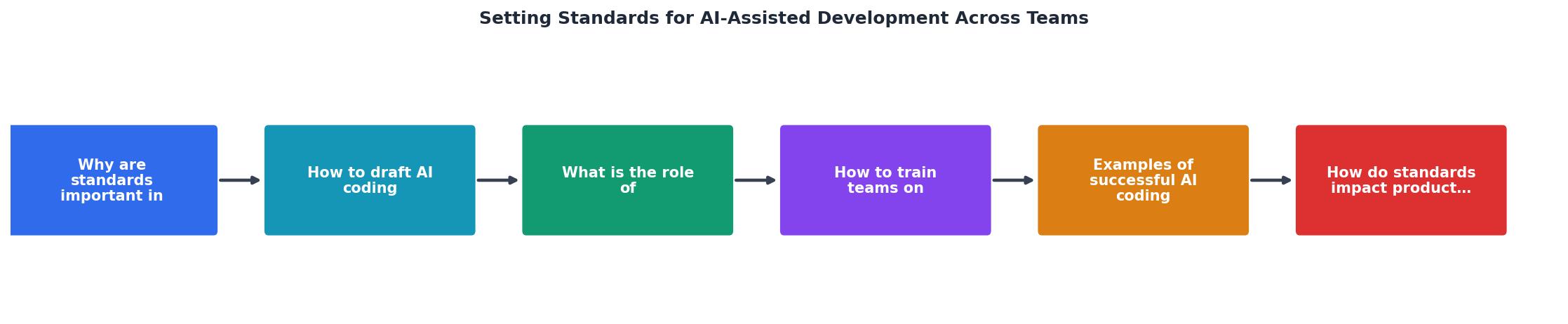
The process follows a clear flow: Audit current usage, Draft policy, Review with team, Pilot on one project, Iterate based on feedback, Roll out org-wide. Each step feeds into the next. Skip the pilot phase and you end up rewriting the policy three times.
Code reviews in AI development

Code review is where AI standards either hold or collapse. The review process needs specific adaptations for AI-generated code because the failure modes are different from human-written code.
AI-specific review concerns:
- Plausible but wrong logic. AI-generated code compiles, passes basic tests, and reads cleanly. But it sometimes implements a subtly incorrect algorithm. Reviewers need to verify correctness, not just style.
- Dependency bloat. AI tools frequently import libraries the project does not need. A reviewer should check whether new dependencies are justified and approved.
- Test quality vs. test quantity. AI can generate 50 test cases in seconds. Most of them test the happy path with minor variations. Reviewers should look for edge cases, error paths, and integration scenarios.
- Security anti-patterns. AI models trained on public repositories reproduce common vulnerabilities. SQL injection via string concatenation, missing authentication checks, and exposed API keys appear regularly in AI output.
A practical approach: create a review checklist addendum specifically for PRs that include AI-generated code. Three to five extra items on the existing checklist. Not a separate process, just an extension of what already works.
| Review Without AI Standards | Review With AI Standards |
|---|---|
| Reviewer guesses what was AI-generated | PR description tags AI-assisted sections |
| Same checklist for all code | Extra checks for AI-specific failure modes |
| Security scanning optional | Mandatory SAST on every AI-touched file |
| No prompt context available | Prompt or session summary linked in PR |
| Inconsistent acceptance criteria | Clear pass/fail gates for AI output |
The difference is not about adding friction. It is about making the existing review process effective for a new type of input.
Train teams on AI tools

Publishing a policy document and expecting adoption is a classic engineering management mistake. Training is what turns a policy into a practice.
Structured onboarding sessions. Run a 90-minute workshop where the team works through real scenarios using the approved AI tools with the new guidelines applied. Not a slide deck. Actual coding, actual prompts, actual reviews.
Pair programming with AI. Pair a developer experienced with AI tools with one who is not. They work on a real ticket together, with the experienced developer demonstrating prompt construction, output evaluation, and the review process. Two sessions of this teach more than any documentation.
Prompt libraries. Build a shared repository of effective prompts for common tasks in your codebase. "Generate a REST endpoint following our service pattern" with the actual system prompt and context files attached. New team members start from working examples instead of blank prompts.
Weekly retros on AI usage. Dedicate 15 minutes of the weekly retro to AI-specific topics. What worked? What produced garbage? What pattern should we add to the prompt library? This creates a feedback loop that keeps the standards alive and evolving.
Teams that maintain shared prompt libraries report that new developers reach productive AI usage roughly three times faster than those who start from scratch. The library encodes institutional knowledge about what works with your specific codebase, frameworks, and conventions.
Real-world AI coding standards
Abstract principles are useful. Concrete examples are better. Here are patterns from organizations that have shipped AI coding standards successfully.
Shopify requires developers to treat AI-generated code with the same scrutiny as code from an unknown contributor. Their internal guidelines emphasize that the developer who commits the code owns it completely, regardless of whether a human or AI wrote the first draft.
GitLab publishes their AI coding guidelines publicly. They mandate that AI-generated code must include tests, must pass all existing CI checks, and must not introduce new dependencies without explicit approval. Their approach treats AI as a junior developer whose output always needs review.
Stripe focuses on security-first AI policies. Any AI-generated code that touches payment processing, authentication, or PII handling goes through an additional security review, separate from the standard code review. This layered approach lets teams move fast on low-risk code while maintaining strict controls where it matters.
The common thread: none of these organizations banned AI tools. They all created structured frameworks that channel AI productivity through existing quality gates.
Here is an example dashboard showing how a typical engineering team might track AI standards compliance across key metrics:
AI Standards Compliance Dashboard
Example: 12-person engineering team, Q2 sprint cycle
Standards boost productivity
The objection engineering leads hear most often: "Standards slow us down." The data says the opposite.
When every developer follows the same prompt patterns, uses the same context files, and submits PRs in the same format, three things happen:
- Review cycles shorten. Reviewers know what to expect. They spend less time understanding the structure and more time evaluating the logic.
- Onboarding accelerates. New team members copy working patterns from the prompt library instead of inventing their own approach through trial and error.
- Production incidents decrease. Mandatory security scanning and AI-specific review checks catch the vulnerabilities that AI tools commonly introduce.
The productivity gain is not hypothetical. Teams that standardize AI usage report that developers spend less time debugging AI output and more time on high-value architectural decisions. The standards do not eliminate AI's speed advantage. They channel it into consistent, reviewable, deployable code.
The Vibe Coding Bible at vibecodingbible.org covers this topic in depth, with complete policy templates and team adoption playbooks that you can adapt to your organization's specific needs.
Policy template for your team
Use this checklist as a starting point for drafting your own AI coding policy. Each item represents a decision your team needs to make explicitly.
AI Coding Policy Drafting Checklist
Your progress is saved automatically in your browser.
FAQ
Frequently Asked Questions
Additional Resources
- How to implement collaborative AI coding in enterprise teams - Complete guide to implementing collaborative AI coding in enterprise environments. Covers team workflows, security, training frameworks, ...
- Encoding Team Standards - A team standard encoded as an AI instruction does not depend on someone remembering to apply it. The instruction is the application. When a ...
- How to Standardize AI Code Generation Across Your ... - The solution isn't to write less AI-generated code. It's to give AI agents the same standards and conventions that human developers would follow ...