
Software engineering best practices were built for a world where humans wrote every line of code. Today, AI co-pilots write roughly half of what ships in many teams, and the old playbook doesn't quite fit anymore. Code review, testing strategy, architectural decisions, and team workflows all need rethinking. The practices that made sense when you had to read and understand every method are friction points when AI generates the bulk of your code.
Photo by Pavel Danilyuk from Pexels
TL;DR:- AI is rewriting the rules on code review: humans now filter signal from noise rather than verify every decision.
- Development workflows must shift from sequential "write then review" to "generate, validate, iterate" loops.
- Testing, architecture, and team communication need new practices to account for AI's speed and inconsistency.
Key Insight
The fundamental shift in software engineering is not about writing better code—it's about generating more code faster while maintaining reliability through rigorous validation practices.
The Impact of AI on Software Engineering
The traditional software engineering hierarchy was built on scarcity. Code was scarce, time was scarce, and so we built expensive gates: code review, testing, deployment pipelines. We trained ourselves to be careful with each keystroke because corrections were costly. That mindset optimized for quality-per-line-written.
AI demolishes that scarcity model. Code is now abundant. A Cursor session can generate a thousand lines of working code in an afternoon. The constraint has shifted: it's no longer can we write enough code, it's can we trust what we wrote, understand it six months from now, and maintain it at scale.
This reframing matters because it changes which best practices still hold and which ones become bottlenecks.
The old model was: write little, review carefully, ship slowly. The new model is: generate fast, filter ruthlessly, ship frequently. The stakes are lower per-commit (because you generate more) but higher in aggregate (because the volume is staggering).
Changes in Code Review Processes
Code review used to be about verification: did the author implement the spec correctly? Is this secure? Are there edge cases they missed?
With AI, code review is now about validation. The AI generated something plausible. Does it actually solve the problem? Does it fit the codebase style? Are there nonsense hallucinations hiding in the logic?
The review burden doesn't go away, it transforms. You're no longer checking syntax or nitpicking variable names (the AI handles that reasonably well). You're spot-checking architectural choices, looking for subtle logical errors, and ensuring the generated code doesn't introduce security gaps.
This means:
- Review time per PR might drop 40-50% if the code is well-structured and the reviewer knows what they're looking for.
- But review quality depends more on the reviewer's domain knowledge. A junior dev reviewing AI-generated code needs to know what right looks like in your codebase. Otherwise, they'll approve plausible-looking nonsense.
- Automated checks become essential. Linting, type-checking, and basic security scanning filter the obvious problems so humans can focus on logic and intent. Without those gates, reviewers drown in noise.
- PR size expectations shift. You can tolerate larger diffs from AI because you're not reading every line. A 500-line feature from an AI is reviewable; a 500-line feature from a human would be split into smaller PRs for digestibility.
"Any time I have to type precise syntax by hand now [instead of using AI] feels like such a tedious chore.">, When AI writes almost all code, what happens to software engineering?
The risk: you're trading detailed code inspection for speed. That's fine if you have good tests and monitoring. It's dangerous if you don't.
Evolution of Development Workflows

The classic development workflow was linear: design → write → review → test → deploy. You'd spend days on the design phase to reduce rework. Rework was expensive.
AI flips the economics. You can now design-as-you-go: sketch a feature, generate a rough cut, validate it works, iterate. If the AI goes in a wrong direction, you scrap it and regenerate. The cost of rework is low because you didn't invest days of hand-crafting.
This changes your workflow rhythm:
Before AI: Long planning sessions. Write code carefully. One round of review. One round of testing. Ship.
After AI: Quick ideation. Generate a first cut. Run automated tests immediately. If tests pass, iterate on details. Review focuses on "does this actually solve the problem?" not "is the code correct?"
The process diagram below shows how these phases interlock in an AI-assisted workflow:
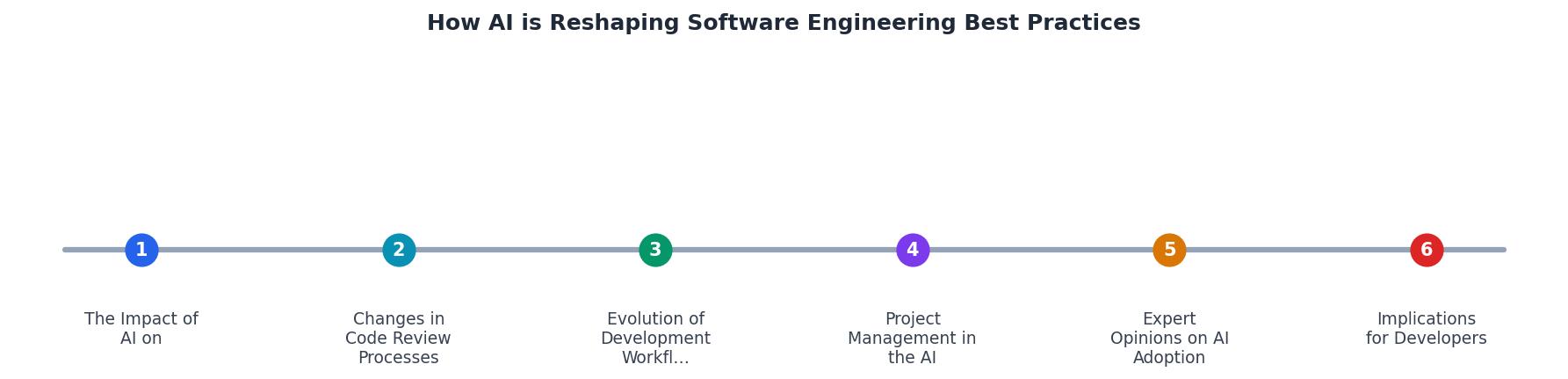
Key workflow shifts you'll notice:
- Feedback loops tighten. You run tests after each generation, not after all coding is done. This catches hallucinations early.
- Documentation generation becomes critical. AI generates code faster than it generates docs. You need a practice of asking the AI to write tests and docstrings alongside the feature, then reviewing those as hard as the code.
- Pair programming with AI changes the dynamic. Instead of two humans collaborating, it's one human + one AI tool. The human's role is to steer, validate, and catch errors the AI misses. This demands active engagement, not passive watching.
- Prototyping becomes disposable. You can now generate a prototype in an hour. If it doesn't validate your assumption, throw it away and try again. This reduces the pressure to "get the architecture right on the first try."
Project Management in the AI Era

When everyone on the team wrote code by hand, predictability was possible. You could estimate a feature, track velocity, and plan sprints. AI breaks this. Velocity becomes unpredictable because some tasks now take half the time and others take twice as long (when AI generates plausible garbage that needs heavy revision).
Teams managing AI-assisted development need different metrics:
- Track AI-assisted PRs separately. Velocity from AI-generated code is not the same as velocity from manual code. They have different quality profiles and maintenance costs. Lumping them together obscures what's really happening.
- Measure code review time, not just lines of code. If reviews drop from 4 hours to 2 hours but the code quality stays the same, that's a win. But if reviews drop to 30 minutes and quality drops with them, that's a loss. Track both.
- Plan for validation time. The total time-to-ship might not change much. You generate faster but spend more time testing and validating. Budget for that.
- Skill variance matters more. A senior dev + AI is dramatically faster than a junior dev + AI. The senior dev knows what to ask for and what to validate. The junior dev generates a lot but ships less-reliable code. This breaks traditional team-size scaling models.
Expert Insights on AI Adoption
The shift to AI-assisted development is hitting teams in waves. Some insights from practitioners:
1. AI output quality is inconsistent by domain. A well-scoped feature with clear specs? The AI nails it. Edge case handling, complex business logic, security concerns? The AI gets it wrong frequently. Best practice: use AI for well-trodden paths, hand-craft for novel territory.
2. Team culture changes matter as much as tooling. If your team treats AI output as "rough drafts to be validated," you'll catch problems. If you treat it as "finished code that needs minor polish," you'll ship bugs. The tool doesn't determine the outcome; the mindset does.
3. Onboarding new team members becomes harder. The codebase grows faster, changes more frequently, and contains patterns the AI favored (not always what humans would choose). New devs need to learn the business domain and understand which code to trust and which to re-examine. This extends onboarding.
4. Technical debt dynamics shift. AI will generate working code that isn't optimal. Over time, your codebase becomes a museum of quick wins. You need aggressive refactoring practices or you'll hit a wall where adding features becomes slow because the foundation is a patchwork.
Implications for Developers
This landscape demands continuous learning. The tools change fast. The best practices are being written right now, in real teams, on real projects. You can't wait for a textbook.
Here's what you need to do:
Stay skeptical of AI output. The tool is good at generating plausible code, not necessarily correct code. A statement can look syntactically perfect and be logically wrong. Your job is to develop a sharp eye for what to trust and what to question.
Deepen your domain expertise. AI is weakest at edge cases, security, and novel problems. If you become the person who understands the business deeply, you become the person who can validate (or reject) what the AI generates. That's leverage.
Learn to prompt well. Using AI effectively is a skill. Write clear specs. Break problems into smaller pieces. Ask for tests alongside the code. The better your prompts, the better your output and the less rework you do.
Embrace test-driven thinking. Tests are no longer optional. They're your primary validation tool. Write a test, ask the AI to make it pass, review the result. This workflow is faster than hand-coding the test and the feature separately.
Build for maintainability. Because AI generates code quickly, it also generates a lot of it. Comment it, document edge cases, keep your architecture clear. Future-you will thank present-you.
Future Trends in AI and Engineering
The practice of software engineering will continue to evolve as AI gets better and teams learn what works.
Agentic coding workflows are coming. Instead of asking an AI to generate a function, you'll describe a task and the AI will break it down, generate code for each piece, run tests, and refactor until passing. The human reviews the final result, not each intermediate step. This is already happening in research; production adoption is next.
Security reviews will become more paranoid, not less. As AI-generated code dominates, attackers will study what AI typically misses. You'll need security specialists who understand both how humans think and how AI hallucinates. General-purpose code review won't catch novel AI-specific vulnerabilities.
Tooling will bifurcate. Some companies will double down on "AI does everything," with light human review. Others will demand "AI assists humans," with heavy validation gates. Both will exist. Neither is universally right; it depends on your risk tolerance and domain.
Career paths will splinter. Some developers will specialize in prompt engineering and AI-assisted rapid development. Others will specialize in deep architecture, security, or complex problem domains where AI is least useful. The "full-stack generalist" will become less common.
Workflow Adaptation Checklist
Here's a practical checklist for adapting your team's workflows to AI-assisted development:
Adapting Development Workflows for AI Tools
Your progress is saved automatically in your browser.
FAQ
Frequently Asked Questions
Additional Resources
- When AI writes almost all code, what happens to software ... - More code generated will lead to more problems, weak software engineering practices start to hurt sooner, and perhaps a tougher work-life ...
- AI in Software Development - From automating code generation to optimizing testing and deployment, AI is reshaping how software is designed, built and maintained.
- AI-Driven Innovations in Software Engineering: A Review ... - The integration of AI is not only transforming traditional workflows but also redefining the skill sets required for modern software engineering professionals.