
Your team's skill gaps are costing you velocity, and traditional training programs aren't moving the needle fast enough. AI-driven learning platforms can personalize skill development at scale, letting engineers learn at their own pace while your team maintains momentum. The question isn't whether to adopt AI for learning, it's how to implement it strategically so it actually sticks.
TL;DR:- AI-driven learning platforms deliver personalized training plans tailored to individual skill gaps and career goals.
- Integration into existing workflows (code reviews, sprint retrospectives, internal wikis) embeds learning into daily work.
- Companies using AI for team development report 30-40% faster skill acquisition and improved retention of junior talent.
- Personalization is the unlock: generic training fails; targeted guidance based on real performance data succeeds.
- Adoption barriers (time constraints, skepticism, poor tool fit) are solvable with clear incentives, leadership modeling, and the right platform choice.
Why AI-Driven Learning Matters for Teams
The traditional conference-and-training model wastes time. Engineers attend a session, take notes, forget half of it by Monday, and rarely apply what they learned. AI-driven platforms flip that: they meet people where they are, inside their editor, inside their code review tool, inside Slack, and deliver just-in-time guidance that maps to real work.
The productivity gains are measurable. When learning is personalized and integrated into workflow, engineers spend less time on ramp-up and debugging knowledge gaps. Retention improves because the learning connects directly to the work they're doing that day. And innovation increases because the team can tackle new technologies and patterns faster, with confidence.
Consider the business impact: reducing ramp-up time for a junior engineer from 6 months to 4 months isn't just a nice-to-have, it's a 25% velocity gain that compounds across hiring. For a team scaling from 8 to 15 engineers, that efficiency difference determines whether you ship new features or thrash.
Integrating AI into Team Training Sessions

Integration isn't a one-time setup, it's a shift in how your team works. Here's where AI tools fit:
During code review: Platforms like GitHub Copilot and Amazon CodeWhisperer can flag patterns, suggest refactorings, and explain why a particular approach is risky. Your reviewers spend less time on low-level style comments and more on architectural feedback. Reviewees learn faster because guidance is specific to the code they wrote.
In sprint retrospectives: AI can analyze sprint data, velocity trends, bug escape rates, cycle time, and surface patterns your team might miss. It suggests targeted training for weak spots. If three engineers struggled with the new async patterns in your codebase, the tool flags that and recommends a focused workshop.
In internal wikis and runbooks: AI agents can generate clear, searchable documentation as your team builds. This reduces tribal knowledge and makes onboarding self-service. New hires can ask the AI agent "How do we handle database migrations?" and get a current, context-specific answer.
During pair sessions: Some teams use AI coding assistants to level-up pairing. A senior and junior pair together; the AI suggests approaches and asks clarifying questions, turning the session into a real-time learning conversation. The junior sees how the senior thinks; the senior discovers new patterns from the AI.
In async standup and demos: Platforms like Slack can integrate AI to automatically synthesize standup notes, flag blockers that need escalation, and suggest relevant training when certain types of problems recur.
The key: don't treat AI training as a separate tool your team logs into "for learning." Embed it into the tools and workflows they already use.
Real-World Examples: Companies Doing It Right
Several organizations have made AI-driven learning central to their engineering culture:
Stripe has integrated AI into code review and onboarding, reducing new engineer ramp-up time significantly. They use Copilot not just for code generation but as a teaching tool, new engineers can ask the assistant about Stripe's patterns and conventions, freeing senior engineers from repetitive explanations.
Figma uses AI to power internal training dashboards that surface learning opportunities based on performance data. If someone struggles with a particular area during code review, the system recommends targeted content, not a 2-hour video, but a focused 10-minute guide.
Shopify has built custom AI coaching into their developer experience, where engineers get personalized feedback on performance reviews tied to learning paths. They've reduced the time-to-productivity for new hires by roughly 30% by combining AI insights with human mentorship.
These aren't unicorn companies with unlimited resources. They're using off-the-shelf tools (GitHub Copilot, internal LLM APIs, platforms like Coursera or O'Reilly) and customizing them to fit their culture. The difference is intentionality: they treat learning as a strategic function, not an afterthought.
Personalization: The Difference Between Failure and Success

Generic training fails. An engineer with 5 years of backend experience doesn't need the same React fundamentals as a frontend expert new to the stack. This is where AI shines: it learns what each engineer knows, where they're weak, what they're interested in, and what they need for their next role.
How personalization works:
- Assess current state. AI analyzes code submissions, test coverage, code reviews, and self-reported skills to build a profile of what each engineer knows and doesn't know.
- Identify gaps against goals. If an engineer wants to become a tech lead, the system identifies what leadership skills they're missing. If someone wants to specialize in infrastructure, it maps their current state to what they need to learn.
- Recommend targeted content. Instead of "here's our full React training," the system says "you need these three patterns; here's a 30-minute guide, then let's have you implement them on our next feature."
- Track progress in context. As the engineer applies the learning in real work (code commits, reviews, shipped features), the system adjusts recommendations. Learning is measured by application, not course completion.
- Surface accountability. Managers can see learning progress tied to business outcomes. Did the engineer close that security knowledge gap? Did cycle time improve? The data tells you whether the learning is working.
"According to the World Economic Forum, 60% of teachers already use AI to handle routine tasks, allowing them to focus on providing feedback and facilitating discussions.">, AI in L&D: Its Uses, What to Avoid & Impacts on Learning & Development
The same principle applies to engineering teams. AI handles the routine parts of training administration and suggestion, freeing your senior engineers to focus on mentorship, feedback, and discussion, the irreplaceable human parts of development.
Overcoming Adoption Barriers

Adoption resistance is real. Engineers often see "learning platform" as busywork piled on top of their already full sprint. Here's how to overcome the predictable obstacles:
Time scarcity: Don't ask engineers to carve out hours for training. Integrate learning into their existing workflow. A 5-minute code review suggestion takes no extra time and teaches a pattern. A Slack summary of a deployment process saves time and adds context.
Skepticism about AI quality: Start small. Let a small group (3-5 engineers) pilot the platform for a month. They'll discover whether the recommendations are useful or noise. Real feedback beats abstract promises. If the pilot team reports better code review experiences and faster onboarding, adoption becomes a pull, not a push.
Wrong tool fit: Not all AI learning platforms work for all teams. A consultancy needs different learning infrastructure than a product company. A team of 40 backend engineers needs something different than a distributed team of 100 mixed-discipline engineers. Evaluate platforms against your actual workflow, not against feature checklists. Can it integrate with your code review process? Does it work in your editor? Can you customize it to your patterns?
Fear of measurement: Some teams worry that tracking learning metrics enables micromanagement. That's legitimate. Be clear: you're measuring outcomes (reduced ramp-up time, fewer escapes, more shipped features), not time spent in training modules. Tie learning to business impact, and people buy in.
Leadership not modeling it: If the CTO and tech leads aren't using AI learning tools themselves, no one else will. You need visibly using these tools, learning in public, and talking about what you've learned. When senior people say "I used AI to get up to speed on this framework" or "the assistant pointed out a pattern I didn't see," it signals that learning is normal and continuous.
Leading a Culture of Continuous Learning
As a tech lead or CTO, your job is to create conditions where continuous learning becomes default, not optional. Here's how:
Make learning visible. In retrospectives and one-on-ones, ask "What did you learn this sprint?" and "What do you want to learn next?" Track learning goals the same way you track shipping goals. If learning is mentioned and measured, it matters.
Allocate time explicitly. Some teams reserve 10% of sprint capacity (one day every two weeks) for learning and experimentation. Others do it differently. The point: don't expect learning to happen in the cracks. Protect time.
Tie learning to career growth. When someone applies new knowledge and ships a feature, recognize it. When someone masters a new skill and teaches it to the team, reward it. Career progression should require demonstrated learning and mentorship, not just tenure.
Customize for roles. A junior engineer learning system design patterns needs different resources than a staff engineer learning to lead teams. An ops engineer building their cloud architecture skills needs targeted content. One generic platform rarely fits all. You'll likely layer multiple tools.
Pair AI with human mentorship. AI is great at explaining "how," but humans are better at "why" and "when." A junior's AI coach can teach Go syntax; their human mentor teaches when Go is the right tool and how it fits into your architecture. Use both.
Celebrate applied learning. In team meetings or all-hands, share stories where someone learned something and it shipped real value. "Jamie learned gRPC patterns from the AI assistant, then implemented our new internal API without anyone blocking her, saved two weeks." Make learning concrete and celebrated.
The Learning Ecosystem in Action
To make this concrete, here's how a typical AI-driven learning process might look at your company:
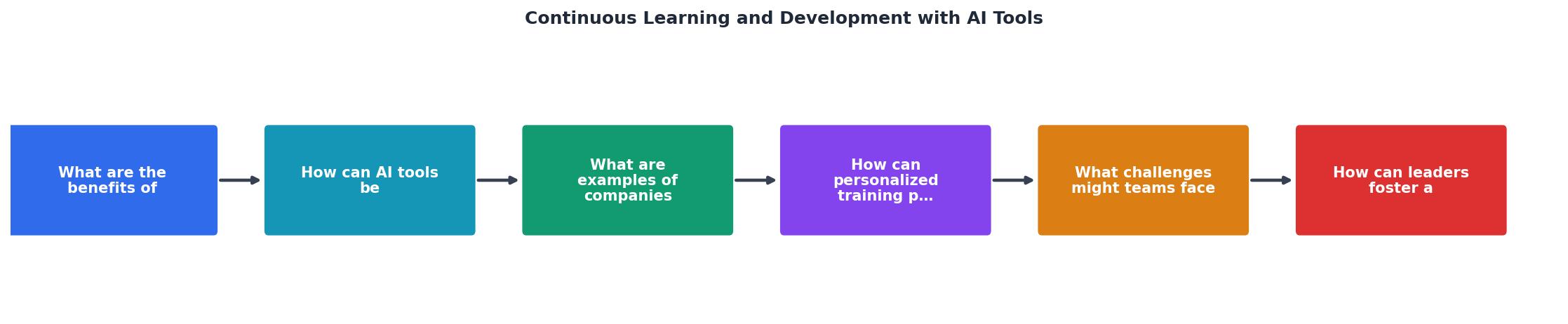
The cycle starts with assessment, the AI understands each engineer's current skills and gaps. Then recommendation suggests targeted learning tied to real work. Integration embeds that guidance into the tools they use daily (editor, code review, Slack). Application means they immediately use what they learned on actual work. Feedback tells them whether they nailed it or need to iterate. The cycle repeats, narrowing gaps and accelerating growth.
This dashboard shows what's possible when you implement AI learning strategically. The numbers vary by team, but the pattern is consistent: faster ramp-up, tighter feedback loops, better retention, and measurable career progress.
Common Mistakes and How to Avoid Them
Many teams stumble on these points:
Mistake 1: Treating AI learning as a "nice to have" rather than strategic. Without intentional time and budget, it never happens. Make it a business objective tied to retention, ramp-up speed, and quality.
Mistake 2: Over-relying on the tool. AI is a coach, not a replacement for mentorship. The best learning happens when the AI handles routine explanations and your senior engineers focus on judgment and guidance.
Mistake 3: Assuming one platform fits everyone. Different roles, levels, and specialties need different learning paths. You may need a mix: Copilot for code learning, O'Reilly or Coursera for deeper topics, internal wikis and Slack bots for culture-specific knowledge.
Mistake 4: Ignoring adoption friction. If the tool takes 10 minutes to access, engineers won't use it. It has to be as frictionless as their existing workflow. Inside the editor. In code review. One-click access.
Mistake 5: Not measuring applied learning. Completing a course is vanity. Shipped features, reduced bugs, faster cycle time, those are real metrics. Track whether learning translates to work.
Implementation Checklist
Implementing AI-Driven Team Learning
Your progress is saved automatically in your browser.
FAQ
Frequently Asked Questions
Additional Resources
- AI in L&D: Its Uses, What to Avoid & Impacts on Learning & ... - AI can improve learning and development through personalized learning paths and adaptive training that boost engagement and knowledge ...
- 5 Best AI Tools for Learning and Development | ClearCo - Using AI learning and development tools can improve engagement, personalize training, and save time. AI L&D tools are a catalyst for more ...
- AI in Learning and Development: A Comprehensive Guide - AI algorithms can automatically create personalized learning paths for employees based on their skills, job roles, and learning preferences, AI ...