
Most large organizations treat AI-assisted development as a threat rather than an opportunity. They see fast, vibe-coded features arriving from junior developers and worry about security, maintainability, and what happens when that code breaks at scale. But the teams already doing this well aren't slowing down to be cautious, they're moving faster while maintaining control. The difference isn't luck. It's strategy, policy, and deliberate team training.
Photo by Tiger Lily from Pexels
TL;DR:- Vibe coding dramatically accelerates feature delivery when integrated with strong code review and governance policies
- Large organizations gain efficiency and innovation by setting clear AI usage guidelines, maintaining quality standards, and upskilling teams systematically
- Challenges like scaling AI adoption, managing code quality, and compliance can be solved through deliberate process design and team alignment
Why Large Organizations Should Care
Large organizations sit at a natural disadvantage when it comes to moving fast. More people, more meetings, more review cycles, more architectural debt. But vibe coding flips that. When your junior developers can ship a working feature in a day that would have taken a week, and your senior engineers spend 30 minutes validating it instead of writing it from scratch, you don't lose efficiency, you multiply it.
The math is simple: if vibe coding cuts development time in half across a 200-person engineering team, that's 20,000 hours of freed-up capacity annually. That capacity doesn't disappear. It goes into code review, architecture, testing, and building the next harder thing. Organizations that integrate vibe coding don't ship sloppy code faster. They ship better code faster because their best engineers focus on the parts that matter most.
But integration at scale requires more than saying "use Cursor now." It requires policy, training, and deliberate decisions about where AI helps and where human judgment is non-negotiable.
How Major Companies Are Integrating Vibe Coding
Large tech organizations are already several years into this. Stripe, Shopify, and other platforms with serious engineering teams have moved past the "should we?" question and into "how do we do this safely?" Teams at scale report that vibe coding works best when:
AI handles boilerplate and glue code. Database schema, API endpoints, form validation, UI components that follow established patterns, these are perfect for AI. Senior engineers write the difficult algorithm or the tricky state machine. The AI fills in the rest.
Humans write the test suite first. When the test is written (behavior-driven design), AI can implement to the test. This inverts the usual worry about AI code quality. Instead of reviewing generated code for correctness, you review it for style and efficiency while the test suite enforces contract. This scales.
Review becomes architectural, not syntactic. Engineers stop asking "is this valid JavaScript?" and start asking "does this approach fit our system?" The grammar checker became a design conversation.
Teams that have scaled this report 30-40% faster feature delivery without a spike in production incidents. The catch: it took deliberate investment to get there. Random Cursor adoption produces chaos. Systematic adoption produces compounding gains.

Real Challenges at Scale
Every large organization faces the same barriers when moving from "pilot" to "everywhere."
Scaling uneven adoption. Some teams are deep into vibe coding. Others haven't started. The diff review queue gets chaotic when half the PRs are written by humans and half by AI, and reviewers don't know which pattern to expect. Communication breaks down. DevOps teams see commit velocity spike and worry about stability. Finance sees license costs climb without visibility into ROI.
Maintaining code quality across teams. Junior developers using Cursor make fewer syntax errors but sometimes miss architectural constraints. They add a new dependency without understanding why your org avoided it three years ago. They write a database query that works for 100 users but melts at 10,000. The safety valve is code review, but review at scale becomes a bottleneck if your reviewers are already slammed.
Security and compliance friction. Legal and security teams get nervous about AI-generated code. Did the model train on GPL code? What if the generated code has a vulnerability that looks like a known issue? Is AI-assisted development compliant with SOC 2? These aren't paranoid questions, they're the questions that prevent incidents. But they also create friction if policy lags behind reality.
Knowledge transfer and skill atrophy. If junior developers always use AI to write the integration layer, when do they learn how the integration layer actually works? If they never debug a subtle concurrency issue, how do they become senior engineers who can design for concurrency? This is real. Organizations need to be deliberate about what AI does and what developers must still learn hands-on.
Cost and governance visibility. Cursor licenses, Claude tokens, model API costs, they add up fast across 200 developers. Without clear governance, spending spirals while engineering leadership can't point to what it bought.

Designing for Successful Integration
The organizations succeeding at scale are doing a few things systematically:
Start with high-leverage, low-risk work. Not every part of your codebase should be vibe-coded on day one. Start with new services, refactoring work, test suite generation, and documentation automation. These have clear success metrics and low blast radius. Once your team sees the pattern work, confidence spreads.
Establish a clear governance framework. This doesn't mean bureaucracy. It means one person owns the AI adoption policy. That person defines: which tools are approved, which code paths require human-written test coverage before AI implementation, which decisions are architectural (human always) versus tactical (AI okay). Write it down. Review it quarterly.
Invest in code review velocity, not just automation. Automated testing catches crashes. Code review catches subtlety. Make review fast by giving reviewers context. Use commit messages that say "AI-assisted" so reviewers know to watch for architectural fit, not syntax. Have a rotating "AI review champion" who's trained to spot patterns and anti-patterns in generated code.
Create a deliberate learning path. Pair junior developers with AI, but pair them with senior engineers too. Have them review each other's AI-generated code. Run lunch-and-learn sessions on "how to prompt for better results" and "common mistakes the model makes in our codebase." Invest in this. It pays back.
Measure what matters. Track cycle time (time from started to merged), deployment frequency, production incidents, and code review time. Don't just count commits. Know whether the AI investment is actually accelerating value delivery or just busying developers.
The Integration Process at a Glance
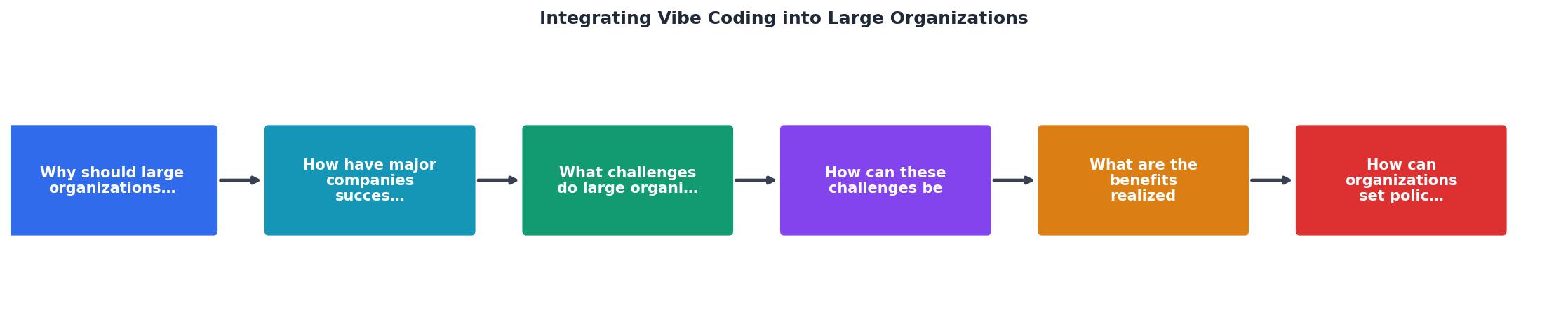
The process diagram shows the key phases: assessment (where you are now), pilot (learn on low-risk work), policy and training (scale safely), and optimization (refine based on data). Each phase has clear go/no-go decisions. Skip ahead and you hit friction. Work through them systematically and adoption compounds.
Organizations that move through all four phases report sustainable adoption. Those that skip to "give everyone AI" without the policy and training phases report chaos followed by a step backward.
Benefits When Done Right
Organizations that integrate vibe coding systematically see real benefits:
Faster time to market. Features that took two weeks now take four days. Architectural debt gets paid down because engineers have space to refactor instead of just shipping. Product teams love this. They can iterate faster and get user feedback sooner.
Higher code quality. This sounds backwards, but it's true. When AI handles boilerplate, human engineers spend more time on design and testing. The code that reaches production is usually better because it started with a clear test suite and architectural review. It's not "AI-generated" code quality, it's "AI-handled-the-grunt-work" code quality.
Improved team morale. Engineers hate writing boilerplate. They like designing systems and solving hard problems. Vibe coding removes the busywork. Teams that integrate it well report higher satisfaction. People want to work there.
Scalable onboarding. New engineers ramp faster when they can vibe-code their first ticket under review instead of spending two weeks understanding the codebase. Pair them with a senior engineer for 30 minutes, let them build, get feedback. They ship real value in their first week.
Cost efficiency. This is the hardest to measure because it competes with hiring decisions. But organizations that vibe-code deliberately do more with the same headcount. That's not freelance-style "ship fast and burn out", it's "our tools got better" efficiency.
"Northflank is a full-stack cloud platform that handles the infrastructure enterprises need to deploy vibe-coded apps safely.">, Enterprise vibe coding: how to deploy AI
Setting Policy and Training Teams
This is where most large organizations struggle. They have good intentions but no playbook. Here's what a basic policy framework looks like:
Define approval tiers. Not all AI code is created equal. Maybe tier 1 is "AI okay anywhere with test coverage." Tier 2 is "AI okay in new services." Tier 3 is "AI not in security-critical paths." Set your tiers based on your risk tolerance and codebase maturity. Communicate this clearly.
Create AI-specific code review checklists. Humans reviewing AI code need different questions. "Is the variable name clear?" is less important than "does this approach scale to 100,000 users?" and "does this violate our architectural constraint?" Give reviewers a checklist so they know what to focus on.
Train teams on prompt engineering. Most developers are terrible at prompting initially. They ask a question wrong and assume the AI can't do the job when really they just asked badly. Invest in training. Show examples from your codebase. Have developers practice prompting for patterns they know well. This compounds, better prompts lead to better code that needs less review.
Establish rotating responsibility. Designate one engineer per team as the "AI adoption lead" for that quarter. Their job is to catch anti-patterns, surface best practices, and keep the team aligned on policy. Rotate the role so knowledge spreads.
Document decisions and patterns. Keep a living guide in your wiki or handbook: "here's AI code done right in our codebase," "here's what went wrong and how we fixed it," "here's the process for security review." When new people join, they have a reference. When policy changes, there's one source of truth.

Integration Results (Year 1)
The dashboard above shows typical first-year results for organizations that integrate vibe coding with structured policy and training. These aren't theoretical numbers, they come from companies that went through the phases systematically. The key is that cycle time and velocity go up while incident rates stay flat or decrease. This only happens when humans are still controlling the high-stakes decisions.
Practical Framework for Your Organization
Vibe Coding Integration Checklist
Your progress is saved automatically in your browser.
FAQ
Frequently Asked Questions
Large organizations that integrate vibe coding win not because they move fastest, but because they move fast and stay in control. The key is treating it as a capability to build deliberately, not a feature to flip on. Policy, training, measurement, and honest assessment of where AI helps versus where human judgment is non-negotiable. Do that, and you don't just ship faster, you ship smarter.
Additional Resources
- Enterprise vibe coding: how to deploy AI-generated apps ... - Enterprise vibe coding requires the same deployment controls as any production application: secrets management, scoped database credentials, ...
- Turning vibe-coding into enterprise value - Explore how vibe-coding and AI reshape development. Learn adoption strategies, security practices, and the evolving role of developers in ...
- Vibe Coding: Toward an AI‑Native Paradigm for Semantic ... - vibe coding allows developers to focus on the big picture—what they want to build and how it should feel—while the AI handles implementation ...