
Your team started using Copilot three months ago. Velocity metrics look great on paper. Then a security audit reveals hardcoded API keys in 14 different files, a junior dev admits they stopped reading the code the AI generates, and your lead architect discovers three microservices that duplicate the same business logic because nobody coordinated. This is what unchecked AI adoption looks like in practice, and it is happening at companies of every size right now.
Photo by cottonbro studio from Pexels
TL;DR:- Unchecked AI adoption introduces code quality variance, security vulnerabilities, and skill atrophy across development teams.
- Governance frameworks, regular audits, and deliberate skill-building programs turn AI from a liability into a controlled advantage.
- Teams that treat AI tooling like any other infrastructure decision (with policies, reviews, and metrics) capture the productivity gains without the blowback.
The real cost of "just use AI"
Every engineering leader faces pressure to adopt AI coding tools. The pitch is compelling: faster feature delivery, reduced boilerplate, happier developers. And the pitch is not wrong. But adopting AI tools without a plan is like giving every developer on your team a power drill and removing the building codes. Speed goes up. Structural integrity becomes a coin flip.
The core risks fall into three categories: inconsistent code quality, expanded attack surface, and gradual erosion of engineering skills. Each one compounds over time. A team that ignores all three simultaneously is building on sand.
"The promise is very clear with AI adoption: faster prototyping, fewer repetitive tasks, and more time for developers to focus on strategy building and innovation.">, Risks of Using AI in Software Development
That promise is real. But promises without guardrails become liabilities.
Three risks that compound silently
Code quality variance
AI coding assistants produce code that looks correct. It compiles. It passes a quick glance. But "looks correct" and "is correct" diverge in subtle ways. Common patterns include:
- Inconsistent error handling across modules because each AI prompt produced a slightly different approach.
- Duplicated logic when two developers ask the AI to solve the same problem independently.
- Outdated patterns because the model's training data includes deprecated APIs and old library versions.
- Over-engineered abstractions that the AI generated to seem thorough but that nobody on the team understands or needs.
Security vulnerabilities
AI models generate code based on statistical patterns. They do not reason about your threat model. Common security issues in AI-generated code include hardcoded secrets, SQL injection vectors, missing input validation, and overly permissive CORS configurations.
That number should concern you. When less than half of AI-generated code passes security review without changes, the review process itself becomes the bottleneck. Teams without mandatory security review for AI output are shipping vulnerabilities at the speed of autocomplete.
Skill atrophy
This is the slow-burn risk. When developers stop writing code from scratch, they stop building the mental models that let them debug, architect, and reason about systems. A junior developer who learns to code exclusively through AI prompts never develops the foundational understanding that makes a senior developer effective.
The pattern is predictable: developers become prompt operators instead of engineers. They can describe what they want but cannot evaluate whether what they got is correct. Six months in, your team's ability to handle novel problems, outages, and architectural decisions has degraded.
Building a governance framework

Governance does not mean bureaucracy. It means clear rules that let your team move fast without breaking things. Here is what a practical AI governance framework looks like for a development team of 5 to 50 engineers.
Define acceptable use boundaries. Specify which tasks AI tools can assist with and which require human-first implementation. Security-critical code paths, authentication flows, and data migration scripts are common candidates for human-first zones.
Standardize tooling. Pick one or two approved AI coding tools. Standardizing reduces the surface area for policy enforcement and makes it possible to configure organization-wide rules (like blocking certain prompt patterns or requiring attribution comments).
Require AI-output markers. Every pull request that includes AI-generated code should tag it. This is not about blame. It is about enabling targeted review. GitHub, GitLab, and Bitbucket all support custom labels and PR templates that make this lightweight.
Set review escalation rules. AI-generated code touching authentication, payments, PII handling, or infrastructure configuration gets a mandatory second reviewer with domain expertise.
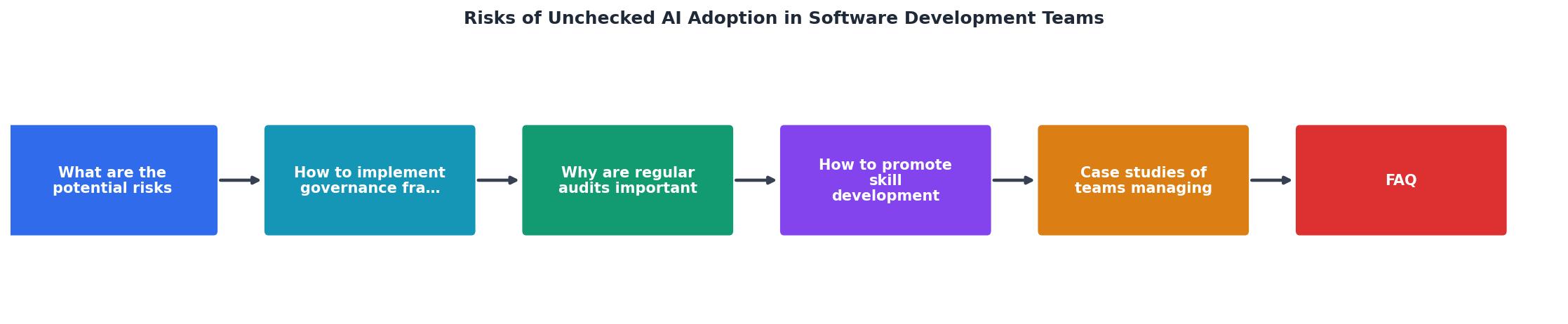
The diagram above shows the flow: Define boundaries, Standardize tools, Tag AI output, Escalate reviews, Audit regularly, Measure outcomes. Each step feeds into the next. Skip one and the chain breaks.
Why regular audits matter

Governance sets the rules. Audits verify they work. Without audits, your governance framework is a document nobody reads after week two.
Effective AI code audits cover three dimensions:
- Quality audits check for consistency in patterns, naming conventions, error handling, and test coverage across AI-generated and human-written code. Run these monthly.
- Security audits scan for known vulnerability patterns in AI output. Tools like Semgrep, Snyk, and SonarQube can flag common issues automatically. Run these on every CI pipeline.
- Dependency audits verify that AI-generated code has not introduced unnecessary or vulnerable dependencies. AI models love importing libraries for problems you can solve in three lines.
Teams that audit AI-generated code consistently find and fix issues before they reach production. Teams that do not audit discover problems through incident reports and customer complaints.
Audit cadence that works in practice:
- Continuous: Automated SAST/DAST scans in CI/CD pipelines
- Bi-weekly: Spot-check review of AI-tagged pull requests
- Monthly: Full codebase quality review with metrics comparison
- Quarterly: Security penetration testing with AI-generated code focus
Skill development alongside AI

The goal is not to restrict AI use. It is to ensure your team grows stronger with AI, not weaker without it. Here are concrete strategies that engineering teams are using right now.
Rotate "no-AI" sprints. Once a quarter, run a sprint where the team builds a feature without AI assistance. This surfaces skill gaps, rebuilds debugging muscles, and gives developers confidence that they can still ship without the tools.
Pair programming with AI review. Instead of solo AI-assisted coding, pair one developer who writes with AI and one who reviews in real time. The reviewer builds critical evaluation skills. The writer learns to prompt more precisely.
Architecture ownership. Assign system design and architecture decisions exclusively to humans. AI can generate implementation code, but the structural decisions (service boundaries, data models, API contracts) stay with engineers who understand the business context.
Invest in fundamentals training. Allocate budget for courses and workshops on algorithms, system design, and security. These skills are the ones AI erodes fastest and the ones your team needs most when things go wrong at 2 AM.
The following dashboard illustrates how a typical engineering team's risk profile shifts when governance, audits, and skill development programs are in place versus when AI adoption runs unchecked.
AI Adoption Risk Profile: Unchecked vs. Governed
Lessons from teams that got it right
Shopify's AI coding guidelines. Shopify rolled out internal guidelines for AI-assisted development that include mandatory code attribution, restricted use in security-sensitive modules, and weekly "AI code quality" metrics in their engineering dashboards. The result: they maintained their deployment velocity while keeping their defect rate flat.
GitLab's dogfooding approach. GitLab uses its own AI features internally with strict review policies. Every AI-generated merge request gets flagged automatically, and their security team runs dedicated scans on AI-tagged code. They publish their findings internally, creating a feedback loop that improves both the tool and the team's usage patterns.
Stripe's "understand before you ship" rule. Stripe requires that any developer submitting AI-generated code can explain every line in the diff during code review. If you cannot explain it, you cannot ship it. This single rule has been remarkably effective at preventing both quality issues and skill atrophy.
These are not theoretical frameworks. They are operational decisions made by engineering leaders who recognized that AI adoption is an infrastructure decision, not a feature toggle.
| Unchecked AI Adoption | Governed AI Adoption |
|---|---|
| No review standards for AI code | Mandatory AI-output tagging and review |
| Security scans optional | Automated security scans in every pipeline |
| Developers skip understanding code | "Explain every line" review policy |
| No skill development budget | Quarterly no-AI sprints and training |
| Metrics focus only on velocity | Quality, security, and velocity tracked together |
AI Governance Implementation Framework
Your progress is saved automatically in your browser.
FAQ
Frequently Asked Questions
The Vibe Coding Bible at vibecodingbible.org covers AI governance frameworks, team adoption strategies, and quality control patterns in depth for engineering leaders navigating this transition.
Additional Resources
- Risks of Using AI in Software Development - From insecure code and licensing issues to hidden costs, there are many AI risks that show why unchecked adoption can be dangerous. Ignoring ...
- Preventing Risk with AI in Software Engineering - Studies show that 45% to 60% of AI-generated code samples contain security weaknesses. AI also introduces new attack surfaces through prompt- ...
- Shadow AI: Causes, Consequences, and Best Practices for ... - Shadow AI is on the rise, causing security, compliance, and operational risks. Learn its causes and best practices for managing hidden AI ...