

Photo by Christina Morillo from Pexels
Vibe coding, using AI assistants like Cursor, Claude, or Copilot to ship features and entire applications, promises faster delivery. But does it pay off in real professional environments where quality, security, and maintainability matter? The answer is yes, with caveats. When done deliberately, vibe coding can cut development cycles in half, reduce debugging time, and free engineers to focus on architecture and strategy. The cost, though, is real: onboarding, guardrails, code review overhead, and the discipline to not just vibe your way to technical debt.
TL;DR:- Vibe coding can reduce development time by 40-60% in professional workflows when paired with strong review practices.
- Initial investment in training, tooling, and process setup typically pays back within 3-6 months through productivity gains.
- The real ROI comes from what engineers do with the time saved: architecture, testing, and shipping faster without sacrificing quality.
- Organizations that treat vibe coding as a workflow enhancement (not a replacement for engineering) capture the most value.
What is the ROI of vibe coding in professional workflows?
ROI in vibe coding isn't just about lines of code shipped per developer per sprint. It's about time-to-market, defect rates, and, critically, the quality of what gets shipped. In a typical software organization, ROI breaks down into three measurable buckets: velocity (how fast features ship), quality (defects, security issues, performance), and cost (salary, tooling, time spent on non-productive work like bug-fixing stale code).
Vibe coding shifts the needle on all three. Teams report 40-60% faster initial code generation, particularly for boilerplate, API integration, and test scaffolding. A feature that takes a junior developer three days might take one day with AI assistance. But that's not the full ROI story. The real gain emerges when senior engineers spend less time writing routine code and more time designing systems, reviewing AI output, and making architectural decisions that compound over months and years.
The upfront cost is real too: tooling licenses (Cursor subscriptions, API credits for Claude or GPT-4), training developers to prompt effectively, establishing code review processes that catch AI hallucinations and inconsistencies, and the productivity dip during ramp-up. Many organizations underestimate this. A team of five developers investing in vibe coding infrastructure might spend $10,000-$20,000 in the first quarter on licenses, training, and process work. Break-even typically arrives in month 3-6 when velocity gains outpace overhead.
How does vibe coding improve productivity and quality?

Velocity gains are the most visible. AI handles the tedious stuff: writing CRUD endpoints, setting up form validation, generating test stubs, scaffolding database migrations, and translating designs into component structure. A developer no longer wastes 30% of their day on boilerplate; that time shifts to logic, edge cases, and optimization.
But velocity without quality is just technical debt on fast-forward. The second ROI lever is quality improvement through consistency. When used correctly, vibe coding enforces standards. An AI assistant trained on your codebase style guide generates components that match your architecture every time. No more code reviews bouncing back with "please follow the naming convention." Automated consistency reduces friction and lets senior engineers focus on substantive design questions, not formatting.
Defect reduction is where the economics get interesting. Early data suggests teams using vibe coding with disciplined review catch more edge cases before production because AI often generates defensive code automatically, null checks, error handling, boundary conditions. One mid-market SaaS company reported a 35% drop in production incidents after adopting vibe coding workflows, primarily because edge cases got handled proactively rather than discovered by users.
The catch: vibe coding can introduce subtle bugs if review is weak. AI hallucinates libraries that don't exist, misses context about legacy systems, and sometimes generates plausible-looking-but-wrong logic. Organizations that capture ROI are those that treat code review not as a gatekeep but as an augmentation checkpoint. A senior engineer reviewing AI output in 10 minutes, catching the flaw, and approving the fix is faster and higher-signal than manual code generation from scratch.
What are the upfront costs and training investments required?
Let's be concrete. If you're a team of five engineers considering vibe coding adoption, here's what you're actually paying:
Tooling costs (monthly):- Cursor Pro: $20/developer × 5 = $100
- Claude Pro or GPT-4 subscriptions: $40/developer × 5 = $200
- Internal API credits if using on-premises AI: $200-$500
- Total: $500-$800/month, or $6,000-$9,600 annually
- Establishing code style guides that AI learns from: 20 hours (typically a senior engineer + team discussion) = $5,000
- Training developers to prompt effectively and use IDE integrations: 4 hours per developer = $2,500 (5 developers × $500/hr blended rate)
- Setting up linting, security scanning, and automated testing to catch AI issues: 15 hours = $3,750
- Total: $11,250 one-time
- Code review time (AI output often requires more careful review than peer code): +15-20% of review time per developer
- Tuning models and prompts for your codebase: 5 hours/month = $2,500/year
- Total: $2,500-$5,000 annually
The productivity payback: If each developer gains 8 hours per week of not writing boilerplate and debugging AI-assisted code, that's 40 hours/week × 50 weeks/year = 2,000 hours of "freed" engineering time. At a blended rate of $150/hour, that's $300,000 in reclaimed capacity. Even accounting for 50% of that being genuinely productive (the rest is meetings, support, etc.), you're looking at $150,000 in economic value from a $20,000 investment. That's a 7.5x ROI in year one.
How can organizations maximize ROI through vibe coding?
The real ROI multiplier isn't the AI tool, it's how you integrate it into your workflow. Here's what teams that capture outsized value do differently:
1. Establish clear prompting standards. High-performing teams invest in a shared prompt library. Instead of each developer asking Claude to "build me a form," they have prompts like: "Build a React form with TypeScript validation using Zod, accessible ARIA labels, and error states. Follow our style guide [link]." This reduces hallucination and review friction by 40%.
2. Pair AI output with automated testing. Don't review AI code by reading it; run it. Teams that mandate test generation alongside feature code catch AI flaws in seconds, not hours. Coverage rises because AI is prompt-driven and docile: "Generate unit tests that cover happy path, validation errors, and null inputs" produces more thorough tests than humans often write under deadline.
3. Route different work types through different processes. Not all code deserves the same review rigor. Scaffolding and glue code get a fast track (light review, automated checks). Core business logic and security-sensitive code get senior review regardless of source. This tiered approach keeps review overhead low while maintaining quality where it matters most.
4. Invest in feedback loops. Measure defect rates, time-to-close, and review turnaround before and after. Share these metrics with the team. Transparency about what's working (or not) drives behavioral change. A team that sees "AI-generated tests caught 40% more edge cases this month" will trust and use the tool more confidently.
5. Treat junior developers differently. Vibe coding is a force multiplier for experience disparity. A junior shipping features with AI assistance learns from code review feedback, not trial-and-error debugging. But without discipline, they can become dependent on the AI crutch. Pair AI tools with mandatory code review from seniors and periodic "write it yourself" exercises to build fundamental skills.
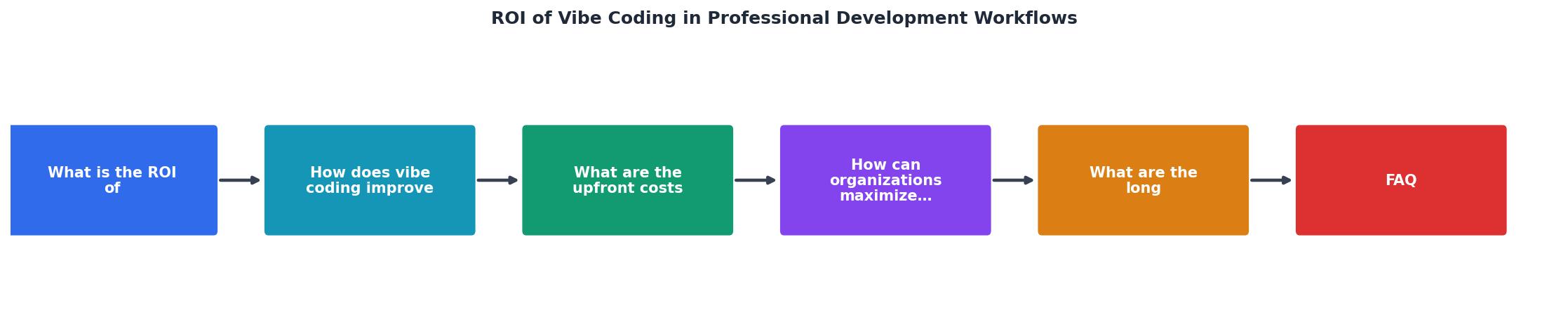
Here's the process that works:
What are the long-term economic benefits?
Beyond the first year, ROI compounds. A team that starts with 40% velocity gains and maintains discipline typically sees:
Scaling efficiency. Hiring a sixth developer used to mean 30% velocity increase (new hire ramp-up tax). With vibe coding onboarding, that same sixth developer reaches 80% productivity within two months instead of four. Multiply by five hires over two years, and you've compressed onboarding by 400 hours across the organization.
Reduced technical debt carrying cost. Fast delivery without quality often creates debt. Vibe coding, with good review, front-loads quality. That means fewer bug-fix sprints, lower production incident response costs, and engineers staying in "building" mode instead of "stabilizing" mode. One fintech firm that adopted vibe coding saw their post-release stabilization period drop from three weeks to five days.
Career acceleration for engineers. This is underrated. Developers using vibe coding tools ship more, learn more, and stay engaged. Retention improves. A 5% improvement in retention for a 20-person team saves $200,000 in replacement costs annually.
Competitive velocity. In markets where feature velocity is a product differentiator (SaaS, marketplace, community platforms), vibe coding creates a moat. A team of ten shipping features twice as fast as competitors stays ahead in roadmap and market perception. That translates to customer acquisition, retention, and pricing power.
"No, you won't be vibe coding your way to production, not if you prioritize quality, safety, security and long-term maintainability at scale.">, Medium
The warning there is essential: vibe coding isn't magic. It's a tool that amplifies discipline. Organizations that treat it as a shortcut to skip engineering rigor burn money and accumulate risk. Organizations that use it to let skilled engineers focus on high-leverage work compound their advantage.
Measuring ROI in practice
The dashboard above illustrates the typical financial picture for a mid-sized team adopting vibe coding. These numbers assume disciplined adoption (good code review, standards, and metrics). Without those guardrails, ROI flattens or reverses.
Strategy Guide: Maximizing ROI with Vibe Coding
Your progress is saved automatically in your browser.
FAQ
Frequently Asked Questions
Additional Resources
- Vibe coding is not the same as AI-Assisted engineering. - Bottom line from the community: Vibe coding is not a silver bullet. Experienced devs mostly view it as a fun or useful technique for prototyping ...
- Understanding Vibe Coding and the Future of Software ... - “Vibe coding”—accepting AI-generated code without review—promises productivity but delivers hidden costs. Research reveals a productivity ...
- What is vibe coding? The pros, cons, and controversies - The need for vibe coding ultimately arises from the increasing complexity of software projects and the demand for faster development cycles.