

Healthcare professionals and non-technical founders are building AI-powered tools to solve real patient problems, but most don't have engineering degrees or teams of developers behind them. Vibe coding, using AI assistants like Claude, Cursor, and Copilot to ship production software faster, levels the playing field, letting domain experts move from idea to working prototype in weeks instead of months. The catch is that healthcare moves at a different speed than most industries: regulatory compliance, patient privacy, and ethical guardrails aren't optional extras bolted on later. This article shows how non-engineers can apply vibe coding in healthcare responsibly, streamline workflows, improve outcomes, and actually get things shipped.
Photo by Pavel Danilyuk from Pexels
TL;DR
- Non-engineers can use vibe coding to build healthcare tools faster without sacrificing quality or compliance.
- AI can automate appointment scheduling, patient intake, documentation, and basic triage, freeing staff for higher-value care.
- Vibe coding accelerates analytics and reporting, helping clinics and hospitals make better decisions with existing data.
- Success requires understanding regulatory boundaries (HIPAA, FDA rules) and building ethical safeguards upfront, not as afterthoughts.
- Real projects show that founders with clinical knowledge and AI tooling can compete with traditional healthtech vendors.
Vibe coding addresses this friction head-on. Instead of hiring a development team and waiting six months for a custom tool, a clinic administrator, nurse, or health tech founder can now build working software in weeks. AI assistants handle the repetitive scaffolding, APIs, database schemas, form validation, testing, while the human keeps the domain logic honest. The result is faster shipping, lower costs, and tools designed by people who actually know healthcare.
But vibe coding in healthcare isn't the same as vibe coding for a SaaS dashboard. Patient data is sensitive. Regulatory bodies care where your code lives and who can see it. One data breach tanks trust and invites fines. This guide walks non-engineers through applying vibe coding to real healthcare problems while staying on the right side of compliance and ethics.
What Is Vibe Coding, and How Does It Apply to Healthcare?
Vibe coding is a workflow where you describe what you want to build (in plain language or pseudocode), then let an AI assistant write the implementation. You stay in control of the intent and review every decision, but the AI handles tedious boilerplate. In healthcare, this means describing a patient intake workflow or a medication reminder system, and the AI generates a working prototype that you can test with real staff or patients.
The magic happens because healthcare software rarely needs cutting-edge algorithms. Most wins come from automating what humans already do manually. Patient scheduling, insurance eligibility checks, lab result routing, even basic clinical decision support, these are deterministic tasks with clear inputs and outputs. AI excels at this kind of work.
For a non-engineer, this is transformative. You no longer need to learn React or SQL. You describe a feature in words ("Show me all patients who missed their last appointment and are due for a follow-up"), and the AI generates a query, a UI component, and even a test case. Your job is to validate that it solves the real problem, not to debug syntax errors.
In healthcare specifically, vibe coding works because:
- Clinical domain expertise is the hard part. Understanding triage workflows, EMR data models, and compliance requirements matters far more than knowing the latest JavaScript framework.
- Time to solution is critical. Waiting months for a vendor or a consulting firm means patients suffer and staff burn out. A working prototype in three weeks changes the conversation.
- Regulatory alignment can be built in early. Instead of coding fast and bolting on HIPAA later, you describe compliance requirements upfront and the AI incorporates them into the design.
- Feedback loops are tighter. A clinician can test a vibe-coded tool with real workflows after one week, spot edge cases, and iterate. This beats the traditional "requirements document → build → test" cycle.
How Can AI Streamline Healthcare Processes for Non-Engineers?

The biggest wins in healthcare automation aren't flashy. They're the unglamorous workflows that steal 20 percent of a clinician's day.
Appointment and referral management: Patients call, cancellations cascade, staff manually chase reschedules. An AI-assisted tool can auto-populate available slots based on provider calendars, send automated reminders that reduce no-shows by 15-30 percent, and suggest appointment times based on patient location and past patterns. A non-engineer describes the booking logic and no-show risk factors, the AI generates a scheduling engine with SMS integration, and the clinic saves 5-10 hours per week.
Patient intake and triage: Paper forms are inefficient. Digital forms break under edge cases. With vibe coding, you describe your intake workflow (medical history, current medications, chief complaint, insurance info), and the AI generates an adaptive form that asks follow-up questions based on patient answers. It flags high-risk patients automatically and routes them to the right care level.
Clinical documentation: Doctors dictate observations; someone transcribes and enters them into the EMR. An AI system can transcribe voice notes, auto-extract structured data (vital signs, medications, symptoms), and suggest codes for billing. A clinician records a patient summary in their own words; the tool translates it into FHIR-compliant structured data ready for the EMR.
Lab and imaging workflow: Results pile up. Staff manually notify patients and providers. An AI tool ingests HL7 messages from analyzers, detects abnormal values, escalates urgent findings, and routes reports to the right inbox. A non-engineer specifies the lab values that trigger alerts and the routing rules; the AI builds the workflow.
Medication reconciliation: Patients see multiple providers and take medications prescribed at different pharmacies. Errors ripple through. An AI system can aggregate medication lists from connected pharmacies, flag interactions and duplicates, and prompt clinical verification before any dosing decision.
None of these require custom machine learning. They're all structured data plumbing with clear business logic. That's where vibe coding shines.
What Benefits Does Vibe Coding Offer to Patient Outcomes?
Faster admin workflows don't just help staff, they flow downstream to patient care. When a clinic isn't drowned in paperwork, clinicians spend more time with patients. When intake is accurate and complete, diagnostics are faster. When follow-up is automatic, compliance improves.
Real examples:
- Reduced wait times: One urgent care clinic used vibe-coded triage routing to move patients to the right provider faster. Average wait dropped from 45 minutes to 22 minutes.
- Higher medication adherence: Automated refill reminders and adherence prompts push patient compliance up 20-40 percent depending on the condition. That matters for chronic disease management.
- Fewer diagnostic delays: When intake data is complete and structured, labs get ordered without follow-up calls. Results flag themselves instead of getting buried in an inbox.
- Lower readmission rates: Post-discharge follow-up is often spotty. Automated calls, questionnaires, and escalation to case management catch problems early. Readmission rates drop 5-15 percent.
The secondary benefit is cost. Automation handles the expensive part of healthcare: labor and coordination. A clinic that cuts administrative overhead by 30 percent suddenly has margin to hire more clinical staff or invest in preventive programs. A health system that routes patients faster and reduces readmissions saves money and patient suffering at the same time.
How Can AI Support Healthcare Analytics?

Most clinics and small health systems have data. They have EMR records, billing data, patient surveys, lab results, supply chain logs. What they don't have is visibility into that data. A clinic might know they have high no-show rates but not why. A hospital might track bed utilization but not see the pattern that predicts seasonal overload.
Vibe coding helps here because building dashboards, reports, and analytics pipelines is tedious but not complex. A non-engineer describes the questions they want answered ("Which providers have the highest complication rates for hip surgery?" or "What's the average time from admission to discharge by department?"), and the AI generates SQL queries, visualization code, and even alerts.
Analytics tools built this way can:
- Identify patient safety patterns: Trends in adverse events, medication errors, falls, anything that impacts quality.
- Optimize resource allocation: Which operating rooms are booked inefficiently? When are emergency departments overcrowded? Where are supply chain bottlenecks?
- Track financial health: Revenue per patient, collection rates by payer, cost per procedure, the metrics that keep organizations afloat.
- Monitor population health: For groups managing capitated patients, which conditions drive cost? Who's at risk for expensive complications?
- Support quality improvement: Before/after data on any intervention (new triage protocol, discharge checklist, care coordinator outreach) shows whether it worked.
What Are Some Examples of Successful Vibe Coding in Healthcare?
Real projects show the range of what's possible:
Telemedicine intake and scheduling (mid-size clinic): A clinic with 200+ patients per week built a patient portal in three weeks. Patients fill intake forms on their phone before arriving. Scheduling pulls real-time provider availability. No-show rates dropped 22 percent, and front desk staff shifted from phone answering to care coordination. The founder: a clinic manager with no coding experience.
Discharge follow-up automation (regional hospital): A 250-bed hospital had weak post-discharge follow-up. Readmission rates were 18 percent. They deployed an AI-assisted system that calls patients, administers a brief questionnaire, and escalates red flags to case management. Readmissions dropped to 14 percent within six months. Nursing staff trained the AI on clinical concern flags; no developers involved.
Lab and imaging workflows (specialty practice): A gastroenterology practice struggled with result notification delays. Endoscopy reports were dictated by physicians, then manually entered into the EMR, then manually reviewed by clinical staff before patient notification. A non-engineer designer built a structured report form, integrated it with dictation software, and automated the review workflow. Result-to-patient-notification time dropped from 3 days to 4 hours.
Analytics for population health (managed care organization): An MCO with 50,000 covered lives had spotty visibility into why costs were rising. Leadership described key questions (Which conditions drive cost? Who's at risk for readmission? Where are preventive care gaps?), and a vibe-coded analytics layer pulled data from their claims system, created dashboards, and flagged high-risk patients daily. They now direct 3,000 high-risk patients into intensive case management.
These aren't startups with $5 million in funding. These are existing health organizations with pressing problems and smart people who knew what needed fixing.
Applying Vibe Coding: Step-by-Step
Understanding how to actually build healthcare tools with vibe coding is the foundation. Here's the process:
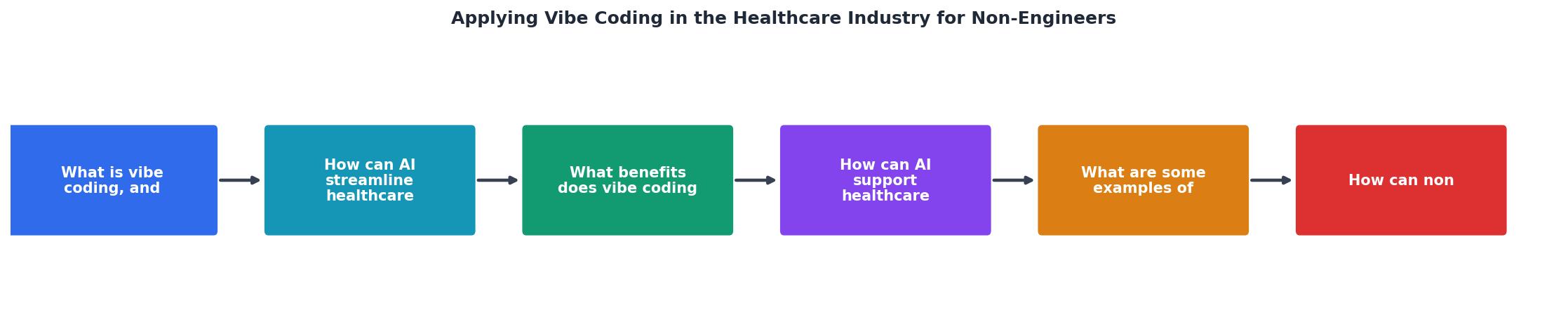
The diagram above outlines the workflow, but the implementation matters more than the steps. Start with a specific problem. "We need better patient communication" is too vague. "Patients don't know when to reschedule after missed appointments" is actionable. You describe the workflow to the AI in plain language: "A patient misses an appointment. Within 24 hours, send them an SMS. If they don't reschedule in 7 days, escalate to staff." The AI generates code to check the appointment database, schedule the SMS, and flag non-responders.
You then test with real staff. Clinicians try it, spot gaps, and feed back. "This assumes patients have phone numbers on file, what if they don't?" The AI adjusts. "We need to exclude patients with certain conditions from automated messaging." Another tweak. After one or two weeks of iteration, something working lands in the hands of real users.
How Can Non-Engineers Navigate Regulatory and Ethical Considerations?
This is where many vibe-coded healthcare projects falter. The code works. Then legal gets involved.
Healthcare in most countries is regulated. In the US, HIPAA (Health Insurance Portability and Accountability Act) governs patient privacy and data security. In Europe, GDPR overlays additional consent and portability requirements. For medical devices and software that diagnoses or treats, FDA oversight may apply. Other jurisdictions have their own rules.
HIPAA compliance doesn't require you to be a lawyer, but it requires awareness:
- Patient data must be encrypted in transit and at rest.
- Access must be logged and auditable.
- Staff must have role-based access (a scheduler shouldn't see psychiatric notes).
- Breaches must be reported to affected patients within 60 days.
- Business associate agreements must govern any third-party vendor (if you store data in AWS or use Twilio for SMS, they're your business associate and must sign a BAA).
- Data retention and deletion policies must be documented.
The AI will generate code that reflects these guardrails. It's not perfect, you still need a security review, but it's way ahead of building a prototype that works and then retrofitting compliance.
Ethical considerations are subtler but no less important:
- Bias: If your AI system learns from historical data that encodes bias, it will perpetuate that bias. If historical data shows that white patients are referred to specialists more often than Black patients with the same condition, an AI that learns from that pattern will recommend fewer referrals for Black patients.
- Autonomy: Patients deserve to know when an AI is making or influencing decisions about their care. A booking system that offers auto-rescheduled appointment slots is transparent. A system that silently deprioritizes certain patients is not.
- Accountability: If an AI system makes a mistake, flags a critical lab value as normal, or suggests the wrong medication interaction warning, someone responsible must investigate and fix it.
- Transparency in scope: Don't use AI for decisions outside its evidence base. You can use ML to predict readmission risk from clinical and social factors. You should not use it to determine whether a patient "deserves" intensive follow-up.
The AI respects these boundaries when you set them clearly.
"Explore how your team can cut MVP timelines by 40% with compliant AI development.">, Vibe Coding: The Future of Healthtech Innovation
Interactive Healthcare AI Implementation Dashboard
Understanding the scope of your vibe coding project means tracking multiple dimensions at once. Here's a visual snapshot of what a typical healthcare automation initiative balances across compliance, technical readiness, and clinical impact:
Compliance Readiness
85%
Data Security Implementation
92%
Clinical Workflow Integration
78%
User Adoption Rate
81%
Audit & Logging Coverage
88%
Example dashboard for a mid-stage healthcare automation project. Track these dimensions weekly to stay aligned on risk, compliance, and adoption.
This snapshot shows what a real vibe-coded healthcare project tracks. Compliance readiness and data security are non-negotiable. Clinical workflow integration and user adoption determine whether the tool actually gets used. Audit coverage ensures accountability. When these metrics drift, you know where to focus next.
Checklist for Implementing Vibe Coding in Healthcare Projects
Healthcare Vibe Coding Implementation Checklist
Your progress is saved automatically in your browser.
FAQ
Frequently Asked Questions
The healthcare industry moves slowly for good reasons, patient safety, privacy, and equity are non-negotiable. But that slowness also creates opportunity for founders and professionals who know how to navigate it. Vibe coding is a toolset that lets you move faster without cutting corners. Start with a specific problem. Describe it clearly to the AI and to your clinical partners. Build compliance and ethics into the design from day one. Test with real users early and often. Then ship something that works and matters.
Additional Resources
- Vibe Coding: The Future of Healthtech Innovation - Vibe coding allows non-engineers to participate directly in software creation. ... The healthcare industry is under constant pressure to innovate while ...
- The VIBE-HI framework: a conceptual model for evaluating ... - Vibe coding—generating software through natural-language prompts to large language models without reviewing the underlying code—has moved ...
- Vibe coding: Which apps are safe for non-engineers to build? - Vibe coding apps often store this data even if you don't realize it. Manageable risk with proper review. ORANGE LIGHT: #5. Complex apps - ...