
AI isn't just accelerating how fast you write code, it's fundamentally changing what problems you can solve and how quickly you can iterate toward novel solutions. When integrated thoughtfully into your development workflow, AI becomes a second brain that spots patterns, suggests alternative architectures, and surfaces opportunities you might have missed under time pressure. The challenge isn't accessing AI; it's using it to drive real innovation without losing the rigor and judgment that separate production-grade software from prototype code.
Photo by Matheus Bertelli from Pexels
TL;DR:- AI identifies new opportunities by analyzing code patterns, performance data, and user behavior to suggest features and optimizations you wouldn't discover manually.
- Streamline development processes using AI to automate boilerplate, refactor at scale, and run parallel experiments, compressing months of work into weeks.
- Innovation happens when AI handles the repetitive thinking, freeing you to focus on architecture, trade-offs, and decisions that require human judgment.
How does AI foster innovation in software projects?
Innovation in software development doesn't mean building the flashiest features, it means shipping solutions faster, with fewer bugs, and discovering possibilities that would take traditional teams months to explore. AI accelerates this by handling layers of routine cognitive work: pattern matching, code generation, test case design, and even risk spotting.
Here's the mechanism. When you feed AI your codebase, architecture decisions, and performance metrics, it can generate multiple implementation approaches for a given problem. You then evaluate which one aligns with your constraints and taste. This isn't replacing your judgment; it's expanding the solution space you can explore in a single afternoon. A junior engineer working alone might consider two or three approaches. That same engineer, paired with AI, can evaluate ten, and learn from each comparison.
The second mechanism is exploration at scale. Traditionally, you pick one direction, build it, test it, measure it. If it's wrong, you iterate. AI lets you sketch multiple directions simultaneously, running them as experiments, comparing outcomes, and pivoting faster. This is especially effective for performance optimization: AI can suggest five different caching strategies, you benchmark them all, and pick the winner in days instead of weeks.
The third is risk reduction disguised as speed. AI doesn't just write code; it generates tests, spots edge cases, and surfaces security considerations early. This shifts innovation from "ship fast and pray" to "ship fast and confident." You're not moving slower; you're moving faster safely.
What methods can AI use to identify new opportunities?
AI excels at finding gaps and patterns in ways humans don't naturally think to look. Here are the concrete methods:
Code pattern analysis. Run your codebase through an AI with strong context retention (Claude with a large window, GPT-4 with retrieval). Ask it to identify repeated logic, anti-patterns, and architectural debt. It will find things: inefficient database queries duplicated across five services, similar validation logic scattered across different endpoints, or opportunities to extract a shared utility that multiple teams are reinventing. Each finding is an innovation opportunity, consolidating these reduces maintenance burden and frees cycles for new work.
Performance and metrics analysis. Feed your monitoring data into AI. Instead of hunting for bottlenecks manually, describe your performance profile and ask for optimization strategies. An AI trained on common patterns will suggest caching layers, query optimization, or architectural changes you might not consider alone. Example: "Our API's 95th percentile latency is 2.3s and we're database-bound. What's the fastest win?"
User behavior and feedback synthesis. Aggregate user feedback, support tickets, and analytics. Ask AI to group them by theme, identify pain points that aren't obvious from individual reports, and suggest features that solve multiple user problems simultaneously. Users rarely articulate what they need; AI can infer it from patterns.
Competitive and ecosystem scanning. Describe your product and competitive space. Ask AI to identify emerging patterns in adjacent tools, suggest features that might differentiate you, or highlight market gaps. This is especially useful for startups: you can run a weekly innovation brainstorm by giving AI access to new competitor launches, industry trends, and your roadmap.
Test case generation and risk spotting. Have AI generate edge-case test suites and security considerations for new features. It won't find all vulnerabilities, but it spots the obvious ones and forces you to think harder. This shifts innovation to "what can we build safely" rather than "what can we build fast."

How can AI streamline development processes?
Streamlining isn't innovation by itself, but it buys you the time and mental space to innovate. Here's where AI reshapes the daily workflow.
Boilerplate and scaffolding automation. Stop writing the same CRUD endpoints, form validation, test harnesses, or configuration files by hand. Describe the shape of the data and the interaction pattern; have AI generate 80% of the code. You review, adjust, and own it. This saves hours per feature and eliminates a source of subtle bugs (because you're not copy-pasting half-baked logic).
Refactoring and code consolidation at scale. Breaking a monolithic module into smaller pieces, or consolidating duplication across services, is intellectually straightforward but tedious. AI can generate the refactoring plan, suggest the new structure, and even produce the diff. You review and test; it handles the busywork.
Parallel experimentation. Need to evaluate three different caching strategies? Three database schemas? Three UI layouts? Have AI generate all three, build them in parallel branches, and benchmark. Pick the winner. In a world without AI, you'd pick one, build it, measure, then commit to it. Now you can compare live.
Documentation and knowledge capture. As code evolves, documentation rots. Have AI generate architecture decision records (ADRs), API documentation, and team runbooks from your code and Git history. It won't be perfect, but it gives you a starting point. You fill in the judgment calls and gotchas; AI handles the facts.
Code review augmentation. Before human review, run your code changes through an AI linter. Ask it to spot potential bugs, suggest alternative implementations, flag performance concerns, and verify you're following team patterns. This catches 30-40% of issues before your teammates see them, making human review faster and focused on architectural decisions rather than style.
"The future of software development is here.">, AI
What are examples of innovative solutions facilitated by AI?
Real examples anchor abstract talk. Here's how AI has driven concrete innovation:
Real-time collaboration features at scale. A team building a document collaboration app used AI to generate the operational transformation (OT) logic and conflict resolution heuristics. Manually coding OT is notoriously complex; AI produced a working version in hours. The team then focused innovation on the UX, what should happen when two users edit the same cell simultaneously? How should the interface signal unresolved conflicts? AI handled the machinery; humans handled the product thinking.
Intelligent caching for a SaaS product. A B2B SaaS team fed AI their database query logs, access patterns, and current caching strategy. AI suggested a multi-tier caching approach: Redis for hot user sessions, in-memory for computation-heavy models, and CDN for static assets. The suggestion wasn't novel, but AI also generated the implementation plan and identified which queries would benefit most. The team shipped it in two weeks instead of two months, freeing them to innovate on feature work.
Automated performance regression detection. Another team used AI to design a system that automatically profiles each code merge, compares it to baseline benchmarks, and flags regressions with explanations of likely causes. This isn't magic, it's good instrumentation plus AI synthesis, but it caught 60% of performance issues before they shipped to production. The innovation: not the tool itself, but the shift from reactive performance troubleshooting to proactive detection.
Security testing without a dedicated team. A startup with no dedicated security engineer used AI to generate threat models and security test cases for each API endpoint and data flow. AI can't replace a real security audit, but it raised the baseline so high that when they hired their first security contractor, they had to fix fewer obvious issues and could focus on architecture-level concerns.

How to integrate AI into creative workflows?
Integration means building AI into your process without letting it dictate your output. Here are concrete patterns:
1. The exploration phase. When approaching a new feature or system, use AI as a sounding board before coding. Describe the problem, constraints, and goals. Have AI suggest three different architectures or implementation strategies. Spend an hour evaluating them. Pick one (or a hybrid). This front-loads thinking and surfaces options you might not discover alone. Cost: an hour. Upside: avoiding a wrong turn that costs two weeks.
2. The rapid prototyping phase. Have AI generate the skeleton of the feature, the happy path, basic error handling, tests. You then iterate on it: add edge cases, refine the design, optimize. Treat AI output as a starting point, not the solution. This is where junior engineers learn fastest: they see a full implementation, understand the structure, then improve it incrementally.
3. The review and refinement phase. Before shipping, run your code through AI review. Ask it specific questions: "Does this handle the edge case where the database is slow?" or "Does this architecture match our patterns?" Use its output to strengthen your confidence or identify gaps you need to address.
4. The documentation and learning phase. After shipping, have AI generate documentation, test case explanations, and ADRs. Review and edit them. This embeds knowledge in the codebase and helps onboard future engineers.
5. The retrospective and optimization phase. Monthly or quarterly, run an AI analysis on your codebase: what's duplicated? What's slow? What's risky? Prioritize fixes, then tackle them. This prevents technical debt from calcifying.
Here's the process diagram that ties it together:
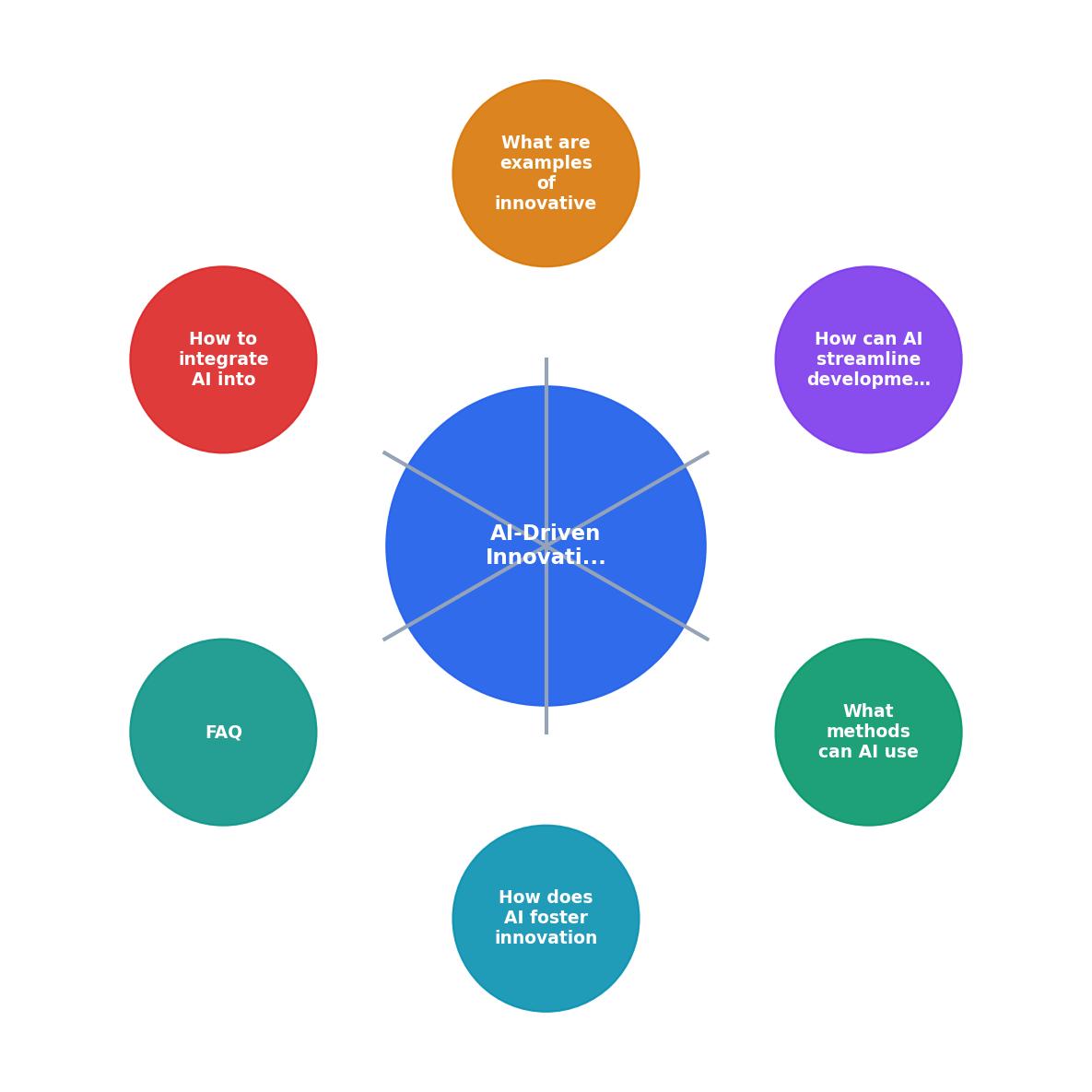
The key at each phase: AI does the heavy lifting on generation and analysis; you provide judgment on what matters and what to build.
Practical AI-driven innovation workflow
Use this checklist to integrate AI into your next feature cycle:
Guide for Integrating AI into Innovative Software Projects
Your progress is saved automatically in your browser.
Custom interactive AI-driven workflow overview
Here's a visual summary of how AI fits into your development cycle, from ideation through deployment and optimization:
Explore & Design
Define the problem and constraints
Generate & Scaffold
Create boilerplate and base implementation
Review & Strengthen
Add edge cases, optimize, test
Document & Deploy
Write ADRs, docs, and ship
Measure & Optimize
Monitor performance and gather feedback
The workflow above shows where AI contributes and where your judgment is critical. AI handles generation, pattern spotting, and busywork. You own architecture, trade-offs, risk assessment, and the final decision. Innovation happens at the intersection: you're free to think strategically because AI is handling the mechanical thinking.
FAQ
Frequently Asked Questions
Additional Resources
- AI-Driven Development Life Cycle: Reimagining Software ... - AI enhances quality by consistently applying organization-specific standards – your coding practices, design patterns, and security requirements ...
- AI-Powered Software Innovation: What's Changing in 2026 - AI-powered innovation software leverages artificial intelligence technologies to automate and optimize the process of creating new products, ...
- AI-Driven Innovations in Software Engineering: A Review ... - Key areas of impact include automated code generation, intelligent debugging, predictive maintenance, and enhanced decision-making processes. AI is ...
Ready to Master Vibe Coding?
Learn to build software faster with AI assistance using the Vibe Coding Bible.
Get Started