

Multi-platform codebases break in ways single-platform ones don't. A feature works perfectly on iOS but crashes on Android. The web version handles payment differently than the desktop app. You push a fix and suddenly three other platforms regress. When you're shipping with AI, these inconsistencies multiply because each platform's codebase gets generated and modified separately, and the AI models don't inherently understand cross-platform implications.
Photo by jamies.x. co from Pexels
TL;DR:- Use unified codebases and shared libraries to reduce platform-specific deviations.
- Implement automated cross-platform testing and CI/CD pipelines before AI generates code.
- Leverage AI for consistency checks, linting, and automated validation across platforms.
- Document platform-specific requirements upfront so AI has clear constraints.
- Monitor and audit AI-generated changes across all platforms simultaneously.
The Cross-Platform Consistency Challenge
Shipping the same product across web, mobile, and desktop means managing three separate codebases (or more). Each platform has its own language, framework, tooling, and ecosystem. When you add AI-assisted development into the mix, the problem compounds: different AI models may generate solutions in different styles, different error-handling patterns, and different performance characteristics for the same logical feature.
The core issue is that consistency isn't just about code style. It spans business logic, data models, API contracts, error handling, user experience flows, and performance baselines. A CTO must ensure that when a user completes an action on iOS, then opens the web app on their laptop, they see the same state, the same UI patterns, and the same data consistency guarantees.
Cross-platform inconsistencies are expensive. A bug that exists only on one platform is often discovered too late, after users have encountered it. Fixing it retroactively requires coordinating changes across separate codebases, re-running all tests, and managing rollouts. With AI generating much of the code, you need guardrails before that generation happens, not after.
Unified Codebases: The Foundation
The most effective way to enforce consistency is to reduce the number of separate codebases you maintain. This doesn't mean writing everything in JavaScript for the web and recompiling it for iOS. It means using shared libraries, monorepos, and code-generation tools to ensure that core business logic lives in one place.

Monorepo architecture lets your iOS, Android, web, and backend code live in a single repository with shared tooling and a unified version history. Tools like Nx, Turborepo, or Bazel let you split the logical structure while keeping dependencies transparent. When you ask an AI tool to implement a feature, it can see the full codebase context, including shared libraries and existing patterns.
Shared domain models are critical. Define your data structures, validation rules, and business logic in a language-agnostic way. If you're using TypeScript, consider generating types from a schema (OpenAPI, Protobuf, or GraphQL). Every platform's code then uses the same types for the same concepts. An order, a user, a transaction: these have the same shape everywhere. AI models respect structure; when they see a well-defined schema, they're more likely to apply it consistently.
API contracts as the source of truth isolate your client apps from backend changes and enforce a single interface. Use OpenAPI or GraphQL to define what the backend exposes. Client code (iOS, Android, web) is then generated from that contract or written against it, not guessed at. When the backend changes, all clients see the same change reflected in their generated code.
"Moreover, consistent presentation of a brand has been shown to increase revenue by up to 23%.">, How to Maintain Brand Consistency in an AI
Tools like NativeScript, Flutter, or Tauri let you write core logic once and deploy to multiple platforms. If your constraints allow it, these can drastically reduce inconsistency. But not all projects fit this model. If you're locked into native development, a monorepo with aggressive code sharing is the next best thing.
Cross-Platform Testing as a Gating Function
AI-generated code must pass tests before it ships. But tests alone aren't enough; you need cross-platform tests that verify the same behavior on all platforms simultaneously.

Contract testing is your first line of defense. Every client (iOS, Android, web) and the backend agree on a contract. When any code is generated, it runs against tests that verify it adheres to that contract. Contract tests are fast, language-agnostic, and catch inconsistencies immediately. If the iOS client generates code that doesn't match the API contract, the test fails before code review.
Behavior-driven testing (BDD) lets you write tests that describe what should happen, not how. Gherkin syntax (Given, When, Then) can be run against any platform. The same scenario runs on web, iOS, and Android. If a feature passes the web test but fails on Android, you catch it in CI before merging.
Synthetic monitoring in production verifies consistency across platforms in real time. Run the same transaction on all platforms every few minutes and alert if they diverge. This won't catch everything, but it catches surprises: a payment success on web but a timeout on mobile; a state sync that works on iOS but not Android.
Set up a CI/CD pipeline where AI-generated code triggers:- Unit tests for the specific platform.
- Contract tests against shared interfaces.
- Integration tests that touch the backend.
- BDD scenarios run on all platforms.
- Performance benchmarks compared to baseline.
AI-Powered Consistency Checks
This is where AI becomes not just a code generator but a code reviewer. Use AI to enforce consistency rules across your platforms automatically.
Linting with semantic understanding goes beyond style rules. You can train or configure AI tools to detect when the same logical pattern is implemented differently across platforms. For example, an error-handling function on iOS that doesn't match the error-handling pattern on web. An AI linter can flag this, or even generate a fix.
Automated refactoring keeps code aligned as patterns evolve. When you decide on a new error-handling standard or logging pattern, an AI tool can propagate that change across all platforms in a single pass. Manual refactoring would take days and introduce inconsistencies.

Consistency checkers can compare code across platforms for semantic equivalence. Two implementations of the same feature in different languages should handle the same edge cases. An AI can read both and flag if one handles null inputs but the other doesn't, or if one retries on network errors while the other doesn't.
Tools like SonarQube, Checkmarx, or custom GitHub Actions with AI backends can be configured to run these checks as part of your CI pipeline. When code is committed, the checks run. If violations are found, the PR is flagged or blocked. Over time, this creates a feedback loop where your codebase converges toward consistent patterns.
Use AI to generate platform-specific test cases that exercise the same scenarios. If you're testing user registration, generate the test for web, iOS, Android, and backend simultaneously. Each test is written in the appropriate language and uses platform idioms, but they all verify the same business logic.
Process Diagram: From Development to Deployment
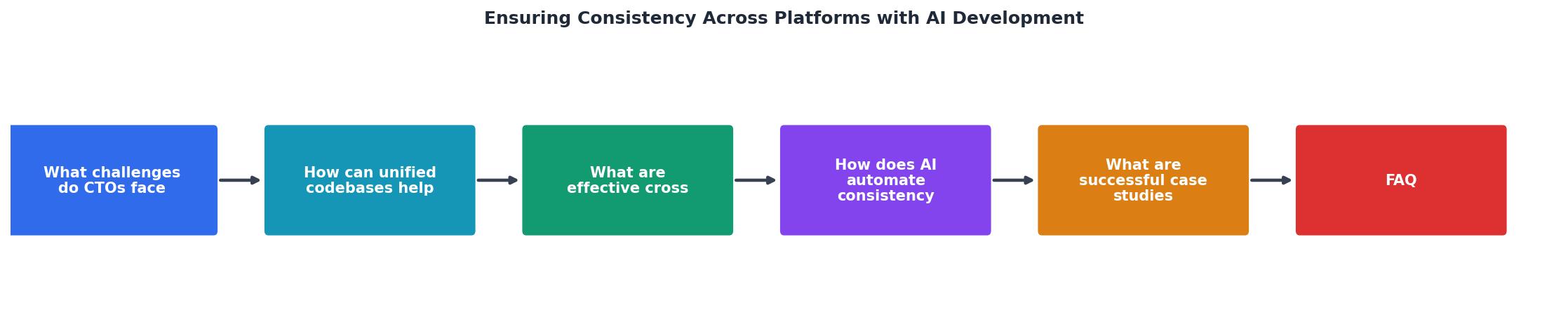
The diagram above shows how a feature flows through the consistency pipeline:
Define the feature in a shared spec or schema. Generate code for each platform using AI, referencing the shared spec. Test the code on all platforms simultaneously (unit, contract, BDD, performance). Review the code with AI-powered consistency checks. Merge only when all checks pass. Deploy confidently, knowing all platforms are aligned.
Real-World Implementation: Building in Phases
Start small. Pick one non-critical feature and implement it across all platforms using your unified approach. Document what worked and what didn't. Then scale.
Your first phase should establish:- A monorepo or clear shared library structure
- Shared types or schemas for core domain models
- A contract-testing approach (Pact, or your own assertions)
- A CI pipeline that tests all platforms
- BDD scenarios that run on all platforms
- AI-powered linting and consistency checks
- Automated refactoring for pattern changes
- Synthetic monitoring in production
- Automated performance comparisons across platforms
- Team workflows that assume consistency checks (i.e., they never ship code that doesn't pass)
Cross-Platform Consistency Setup Checklist
Your progress is saved automatically in your browser.
Now, here's an interactive dashboard showing how a typical multi-platform team tracks consistency metrics:
Platform Consistency Status
The dashboard above shows what a healthy multi-platform team should track. Contract test pass rates above 95% indicate your API contracts are stable. Platform-by-platform status checks show which systems are in sync. The consistency score reflects how many of your cross-platform validations pass. When you see anomalies (inconsistencies detected or a single platform failing), that's your signal to investigate before shipping.
FAQ
Frequently Asked Questions
Additional Resources
- Toward Consistency in the Logical Structures of Datasets ... - The aim of this article is to explore potential directions for the development of artificial intelligence (AI). It points out that, while current AI can ...
- How to Maintain Brand Consistency in an AI-Driven World - Discover six proven AI-powered strategies for maintaining brand consistency across all touchpoints.
- How does AI content generation handle brand consistency? - AI content generation manages brand consistency through intelligent systems that can be trained to understand and implement specific brand ...
Ready to Master Vibe Coding?
Learn to build software faster with AI assistance using the Vibe Coding Bible.
Get Started