Ensuring Responsible AI Usage in Coding Projects
AI code generation tools produce thousands of lines per day across your team. Some of those lines carry biases baked into training data, leak sensitive patterns, or generate outputs nobody can explain to an auditor. Responsible AI usage in coding is not a philosophical exercise. It is a concrete engineering discipline with checklists, metrics, and review gates that protect your users and your reputation.


AI code generation tools produce thousands of lines per day across your team. Some of those lines carry biases baked into training data, leak sensitive patterns, or generate outputs nobody can explain to an auditor. Responsible AI usage in coding is not a philosophical exercise. It is a concrete engineering discipline with checklists, metrics, and review gates that protect your users and your reputation.
Photo by Markus Winkler from Pexels
TL;DR:- Responsible AI usage requires explicit bias checks, transparency mechanisms, and ethical review gates integrated into your CI/CD pipeline.
- Treat AI-generated code with the same scrutiny as third-party library code: audit inputs, validate outputs, document decisions.
- Measurable metrics like fairness scores, explainability coverage, and incident tracking turn ethics from aspiration into engineering practice.
Principles of responsible AI usage
Every engineering team using AI-assisted coding operates under a set of assumptions, whether they have written them down or not. Making those assumptions explicit is the first step toward responsible usage. Five principles form the foundation:
- Fairness means AI outputs do not systematically disadvantage any user group. A recommendation algorithm trained on biased data will reproduce that bias in production.
- Transparency requires that every AI-generated artifact can be traced back to its prompt, model version, and review decision.
- Accountability assigns a human owner to every AI output that reaches production. The model did not ship the code. You did.
- Privacy ensures training data, prompts, and outputs do not leak personally identifiable information or proprietary business logic.
- Robustness demands that AI-generated code handles edge cases, adversarial inputs, and unexpected data distributions gracefully.
That number reflects a gap between adoption speed and governance maturity. If your team lacks a written policy, you are already behind.

Implement bias checks in AI projects

Bias does not announce itself. It hides in training data distributions, prompt phrasing, and model selection. Catching it requires deliberate, repeatable processes.
Data auditing is the starting point. Before feeding any dataset into a model or using AI to generate code that processes user data, profile the dataset for demographic representation, label distribution, and historical skew. Tools like IBM AI Fairness 360 and Google What-If Tool let you visualize disparities before they become production bugs.
Prompt review matters just as much. A prompt that says "generate a user profile validation function" might produce code that assumes Western name formats, binary gender fields, or US-centric address structures. Review prompts for implicit cultural assumptions. Keep a shared prompt library with annotations about known bias risks.
Output testing closes the loop. Run AI-generated code against diverse test fixtures:
- Names with diacritics, non-Latin scripts, and single-character surnames
- Addresses from multiple countries and postal systems
- Edge-case dates (leap years, different calendar systems)
- Accessibility scenarios (screen reader compatibility, color contrast)
bias-check label to your pull request template. Any PR containing AI-generated code that touches user-facing logic must pass a bias review before merge.The adoption rate for automated bias testing remains low. Integrating even basic fairness assertions into your test suite puts you ahead of most organizations.
Ensure transparency in AI outputs
Transparency is not about dumping model weights into a README. It is about creating an audit trail that answers three questions: What did the AI generate? Why was it accepted? Who approved it?
Provenance tracking logs the model name, version, temperature setting, and full prompt for every AI-generated code block. Store this metadata alongside your commit history. Some teams use Git notes or a dedicated ai-provenance.json file per module.
Explainability annotations add inline comments to AI-generated code explaining the reasoning. Not every line needs a comment, but decision points do. If the AI chose a specific algorithm, data structure, or error-handling strategy, document why a human reviewer agreed with that choice.
Decision logs record when a team overrides or modifies AI output. A simple markdown file per sprint works:
## Sprint 42 - AI Decision Log
- PR #891: AI suggested recursive approach for tree traversal. Replaced with iterative to avoid stack overflow on deep trees. Reviewer: @engineer_name
- PR #903: AI-generated SQL query used SELECT . Narrowed to specific columns for performance. Reviewer: @engineer_name
This log becomes invaluable during incident reviews and compliance audits.
"The rapid uptake of AI-assisted and AI-generated (or "vibe") coding may be one of the biggest shifts in research methodology since the advent of the computer.">, Responsible use of AI in research software*
Integrate ethics into daily workflows

Ethics cannot live in a quarterly review meeting. It needs to be embedded in the same tools and rituals your team already uses.
Code review checklists should include ethical criteria. Add items like "No hardcoded assumptions about user demographics" and "AI-generated logic reviewed for fairness" to your PR template. These items carry the same weight as "Tests pass" and "No security vulnerabilities."
Sprint retrospectives should include an ethics check-in. Dedicate five minutes to asking: "Did any AI-generated code this sprint raise ethical concerns? Were they addressed?" This normalizes the conversation without adding a separate meeting.
Pair programming with AI works best when the human partner actively questions the AI's choices. Do not accept the first suggestion. Ask the AI to explain its reasoning, then verify independently. Treat AI output like code from a new team member who has not yet earned your trust.
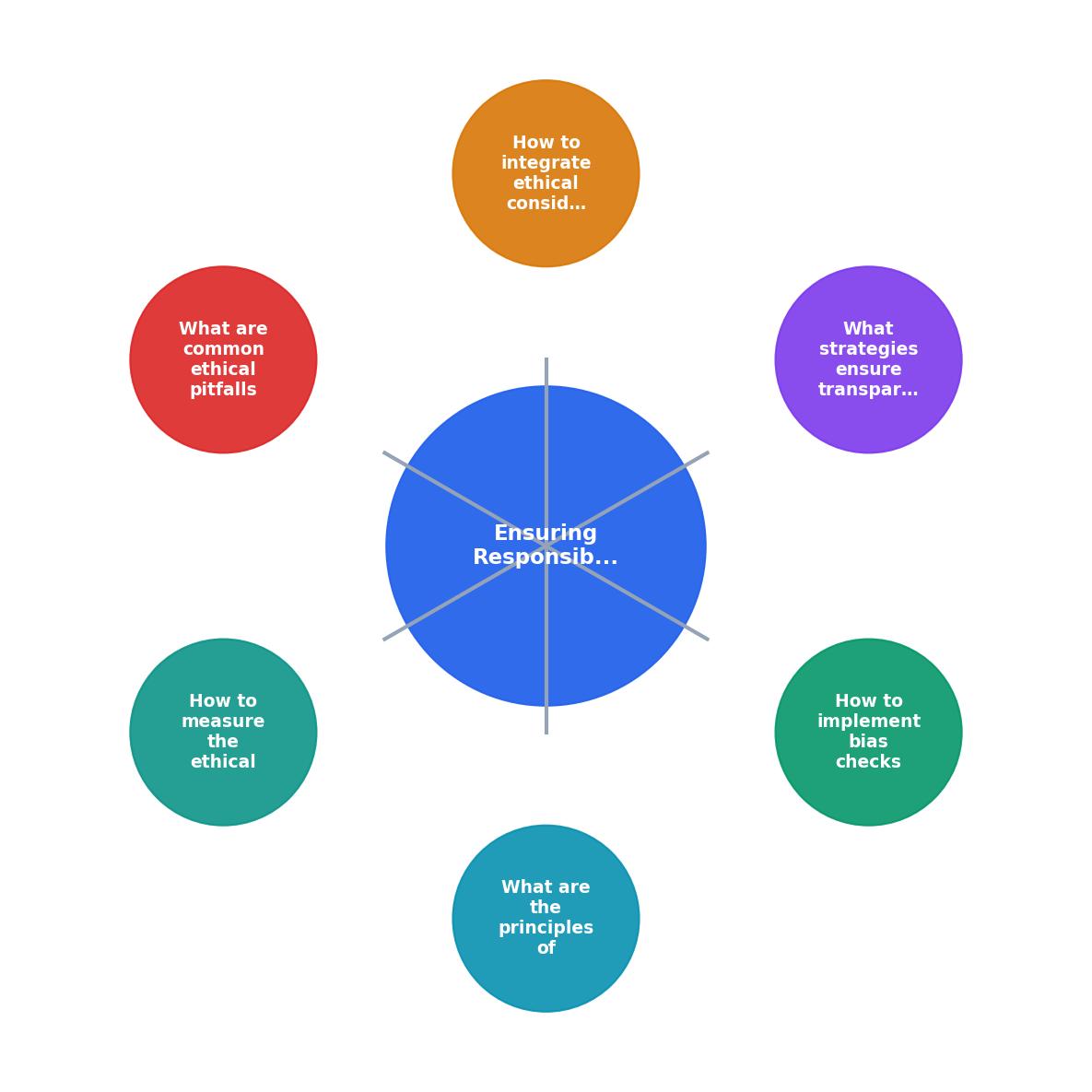
The process follows a clear loop: Define Principles, Audit Data, Review Prompts, Test Outputs, Log Decisions, Measure Impact, and Iterate. Each step feeds into the next, creating a continuous improvement cycle rather than a one-time checkbox exercise.
Common ethical pitfalls
Knowing what goes wrong helps you build better guardrails. Here are the pitfalls that catch experienced teams:
- Automation bias occurs when developers trust AI output simply because it came from a model. The code compiles, the tests pass, so it must be correct. But "correct" and "ethical" are different standards. A function can return accurate results while systematically disadvantaging a user group.
- Prompt injection leakage happens when AI-generated code inadvertently exposes prompt content or training data patterns. If your prompts contain business logic, API keys, or internal naming conventions, the generated code might echo those details in comments, variable names, or error messages.
- Monoculture risk emerges when every team member uses the same AI model with similar prompts. The resulting codebase reflects a single model's biases and blind spots. Diversify your AI tools. Use different models for different tasks. Cross-reference outputs.
- Ethics washing is the most insidious pitfall. Teams create an ethics policy document, file it in Confluence, and never reference it again. A policy without enforcement mechanisms is decoration.
Measure ethical impact
What you do not measure, you cannot improve. Ethical AI usage needs quantifiable metrics tracked over time.
The following dashboard shows an example of how a mid-size engineering team might track responsible AI metrics across a quarter. These categories map directly to the principles outlined earlier.
Responsible AI Metrics, Q3 Example
Key metrics to track include:
- Fairness score across demographic groups for any user-facing AI feature. Use statistical parity difference or equalized odds as your baseline metric.
- Provenance coverage measures the percentage of AI-generated code with complete audit trails. Target 100% for production code.
- Ethics review rate tracks how many AI-related PRs received an explicit ethics review. Below 80% signals a process gap.
- Incident count logs ethical issues discovered post-deployment. Track root causes and time-to-resolution.
- Prompt library adoption measures how often developers use reviewed, annotated prompts versus ad-hoc ones.
Review these metrics monthly. Share them in engineering all-hands. When a metric drops, treat it like a failing build: investigate, fix, and prevent recurrence.
| Ad-hoc AI Usage | Governed AI Usage |
|---|---|
| No prompt tracking | Full provenance logs |
| Bias found in production | Bias caught in CI |
| Ethics policy in a doc | Ethics gates in PRs |
| Incident-driven fixes | Metric-driven prevention |
| Individual judgment | Team-wide standards |
Responsible AI Usage Checklist
Your progress is saved automatically in your browser.
FAQ
Frequently Asked Questions
Additional Resources
- Responsible use of AI in research software - For safe and ethical use of AI-coding the main things to take note of are scrutiny, disclosure, and accountability. AI-generated code needs to be carefully ...
- Chapter 3 Ethics of Using AI | AI for Efficient Programming - Ensure the code doesn't expose sensitive data, such as passwords or PII. Don't assume AI-generated content is real, accurate, or current.
- What is the Responsibility of Developers Using Gen AI? - Mark the AI-generated code with clear comments on which tool created it; Document the prompts you used to generate the code for future reference ...
Ready to Master Vibe Coding?
Learn to build software faster with AI assistance using the Vibe Coding Bible.
Get Started