Ethical Guidelines for AI Coding Practices
Your team adopted AI coding tools three months ago. Velocity doubled. Then a customer discovered their personal data leaking through an AI-generated API endpoint that skipped authentication entirely. The productivity gains evaporated the moment legal got involved.


Your team adopted AI coding tools three months ago. Velocity doubled. Then a customer discovered their personal data leaking through an AI-generated API endpoint that skipped authentication entirely. The productivity gains evaporated the moment legal got involved. Ethical guidelines for AI coding are not a nice-to-have compliance checkbox; they are the difference between sustainable AI adoption and a liability time bomb sitting in your codebase.
Photo by Markus Winkler from Pexels
TL;DR:- Responsible AI coding requires explicit policies covering data privacy, bias mitigation, and output transparency.
- Every team needs a documented ethical framework before scaling AI-assisted development.
- Ethical lapses in AI-generated code carry real legal, financial, and reputational consequences that no amount of velocity can offset.
Why ethics matter in AI coding
Most engineering leads treat AI coding tools like faster autocomplete. Type a prompt, get code, ship it. The problem is that AI models carry embedded assumptions from their training data, and those assumptions end up in your production code without anyone reviewing them for ethical implications.
Consider what happens when an AI model generates a user-filtering function. It might default to patterns that inadvertently discriminate based on name structure, location data, or language preferences. Nobody wrote a discriminatory spec. The model just reproduced patterns from its training corpus. Your team shipped it because the tests passed.
Ethical guidelines create a structured checkpoint between AI output and production deployment. They force teams to ask: Does this code handle personal data correctly? Could this logic produce biased outcomes? Can we explain what this system does to a non-technical stakeholder?
Three categories demand attention:
- Data privacy in how AI-generated code handles user information
- Bias mitigation in algorithmic decision-making
- Transparency in what AI systems produce and why
Data privacy in AI-generated code

AI coding assistants generate code that touches user data constantly. Form handlers, database queries, API integrations, logging functions. Every one of these is a potential privacy violation if the generated code does not follow your data handling policies.
Here is what goes wrong in practice:
- Excessive data collection. AI-generated forms often include fields that collect more data than necessary. A registration form prompt might produce code that captures device fingerprints, IP addresses, and browser metadata without any business justification.
- Insecure storage defaults. Models frequently generate code that stores sensitive data in plaintext, uses weak hashing algorithms, or writes personal information to log files.
- Missing consent mechanisms. Generated code rarely includes GDPR-compliant consent flows, cookie banners, or data deletion endpoints unless explicitly prompted.
Practical privacy strategies
Prompt-level enforcement. Include privacy requirements directly in your AI prompts. Instead of "create a user registration endpoint," specify "create a user registration endpoint that collects only email and password, hashes the password with bcrypt, and includes a GDPR consent checkbox."
Automated scanning. Tools like semgrep, bearer, and trufflehog can catch hardcoded secrets, PII in logs, and insecure data handling patterns in AI-generated code. Add them to your CI pipeline.
Data classification tags. Maintain a team-wide data classification document that labels fields as public, internal, confidential, or restricted. AI-generated code that touches confidential or restricted data gets mandatory human review.
Minimal data principle. Train your team to always ask: "Does this code collect or store data we actually need?" If the AI generated a field, that does not mean the business requires it.
.ai-coding-rules file in your repository root that lists privacy constraints. Some AI coding tools (like Cursor) read project-level instructions and apply them to every generation.Bias mitigation in AI systems
Bias in AI-generated code is not theoretical. Amazon scrapped an AI recruiting tool in 2018 because it systematically downgraded resumes from women. The model learned from a decade of hiring data that skewed male. The code worked perfectly from a technical standpoint. It just encoded discrimination.
When your team uses AI to generate logic for scoring, ranking, filtering, or recommending, the same risk applies. The AI draws from patterns in its training data, and those patterns reflect historical biases in the software industry and beyond.
Types of bias to watch for
- Selection bias. AI-generated database queries might filter users based on criteria that correlate with protected characteristics (zip code as a proxy for race, name structure as a proxy for ethnicity).
- Representation bias. Default user personas, test data, and example datasets generated by AI often skew toward Western, English-speaking, male profiles.
- Automation bias. Teams trust AI output more than they should. When the model generates a scoring algorithm, developers accept it without questioning the underlying logic.
Concrete mitigation steps
- Diverse test datasets. Never test AI-generated logic with the default sample data the model provides. Create test datasets that include diverse demographics, edge cases, and adversarial inputs.
- Fairness metrics. For any AI-generated scoring or ranking logic, measure outcomes across demographic groups. Tools like IBM's AI Fairness 360 and Google's What-If Tool provide frameworks for this.
- Red team reviews. Assign a team member to specifically look for bias in AI-generated code during code review. This is not a general review; it is a focused check on whether the logic could produce discriminatory outcomes.
- Document assumptions. When AI generates decision-making logic, document what assumptions the code makes. If a recommendation engine weights purchase history, note that this could disadvantage new users or users from lower-income backgrounds.
"The Observatory showcases information about the readiness of countries to adopt AI ethically and responsibly.">, Ethics of Artificial Intelligence
UNESCO's global framework highlights that ethical AI readiness varies dramatically across regions. If your product serves international users, your bias mitigation strategy needs to account for cultural and regulatory differences.
Transparency in AI outputs
Transparency means two things in AI coding: your team understands what the AI-generated code does, and your users understand what AI-driven features do to their data and experience.
Internal transparency
AI-generated code often works but is not explainable. A developer prompts the model for a caching strategy, gets 200 lines of Redis configuration, and ships it. Six months later, nobody on the team can explain why certain cache invalidation rules exist or what edge cases they handle.
Mandatory documentation. Every AI-generated module that exceeds 50 lines should include inline comments explaining the logic. Not comments the AI wrote (those are often generic), but comments a human reviewer adds after understanding the code.
Provenance tracking. Tag AI-generated code in your version control. A simple convention like [AI-GENERATED] in commit messages or a metadata file lets future maintainers know which code was human-written and which was AI-assisted.
Explainability reviews. During code review, ask: "Can you explain what this function does without reading the implementation?" If the author cannot, the code needs refactoring or better documentation regardless of whether AI wrote it.
External transparency
When AI-generated logic affects user-facing decisions (content recommendations, pricing, access controls), users deserve to know.
- Disclosure labels. If AI determines what content a user sees, label it. "Recommended for you" is better than silently reordering results.
- Appeal mechanisms. If AI-generated logic denies a user access, rejects an application, or flags an account, provide a human review path.
- Audit trails. Log the inputs and outputs of AI-driven decisions so they can be reviewed after the fact.
Ethical AI coding framework
This is where guidelines become operational. A framework gives your team a repeatable process for evaluating AI-generated code against ethical standards.
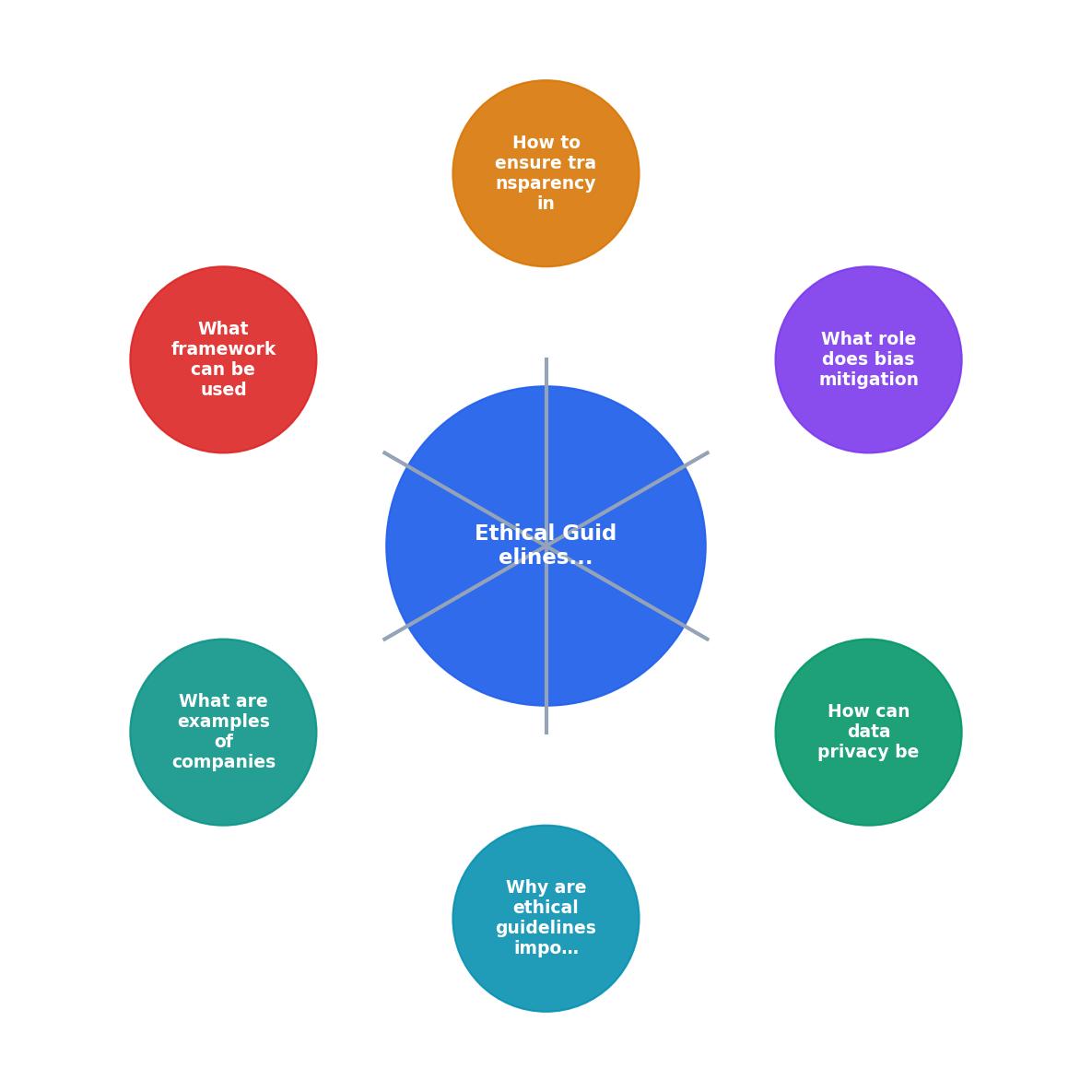
The diagram above outlines the core flow. Here is how each step works in practice:
- Define scope. Identify which AI-generated code touches sensitive areas: user data, decision-making, financial transactions, access control.
- Set policies. Write explicit rules for each sensitive area. "All AI-generated code that handles PII must pass automated privacy scanning before merge."
- Review gates. Add ethical review checkpoints to your CI/CD pipeline. Automated tools catch the obvious issues; human reviewers catch the subtle ones.
- Monitor production. Ethical issues do not always surface in development. Monitor production systems for bias drift, privacy violations, and unexplainable behavior.
- Iterate policies. Update your guidelines quarterly based on incidents, new regulations, and evolving AI capabilities.
Ethical AI Coding Framework
Data Privacy
Enforce minimal data collection, encrypted storage, and consent flows in all AI-generated code.
Bias Mitigation
Test with diverse datasets, measure fairness metrics, and red-team decision logic before shipping.
Transparency
Document AI provenance, explain decision logic, and disclose AI-driven features to users.
Governance
Establish review gates, assign ethical review roles, and codify policies in CI/CD pipelines.
Monitoring
Track production behavior for bias drift, privacy violations, and unexplainable outputs.
Real-world ethical AI examples
Companies that get AI ethics right treat it as an engineering discipline, not a PR exercise.
Microsoft's Responsible AI Standard. Microsoft published an internal standard that requires every AI product to pass a Responsible AI Impact Assessment before launch. Teams must document potential harms, mitigation strategies, and monitoring plans. This is not optional; it blocks deployment.
Google's Model Cards. Google introduced "Model Cards" as standardized documentation for machine learning models. Each card describes the model's intended use, performance across demographic groups, and known limitations. This practice has been adopted across the industry and applies directly to AI-generated code: document what the model does well and where it fails.
Salesforce's Ethical Use Policy. Salesforce explicitly prohibits certain uses of its AI tools, including surveillance and weapons systems. They built ethical constraints into the product itself, not just the terms of service.
These are not small startups experimenting. These are organizations with thousands of engineers who decided that ethical guardrails are a prerequisite for AI adoption at scale.
Consequences of ethical lapses
The risks are not abstract. They show up in specific, measurable ways:
- Regulatory fines. GDPR violations can cost up to 4% of global annual revenue. AI-generated code that mishandles EU citizen data exposes your company to the same penalties as any other code.
- Litigation. Biased AI systems have triggered class-action lawsuits. If your AI-generated hiring tool discriminates, the fact that "the AI did it" is not a legal defense.
- Reputational damage. Users and the press do not distinguish between AI-generated bugs and human-written bugs. A privacy breach is a privacy breach.
- Team attrition. Engineers who care about their craft leave organizations that ship irresponsible code. Ethical guidelines are a retention tool.
Ethical AI coding policy checklist
Ethical AI Coding Policy Implementation
Your progress is saved automatically in your browser.
The Vibe Coding Bible at vibecodingbible.org covers how to integrate these ethical checkpoints into your AI-assisted development workflow without killing team velocity.
| Without Ethical Guidelines | With Ethical Guidelines |
|---|---|
| Privacy violations discovered in production | Privacy issues caught in CI pipeline |
| Bias surfaces after user complaints | Bias detected during code review |
| No documentation of AI-generated code | Full provenance tracking |
| Reactive incident response | Proactive risk mitigation |
| Regulatory exposure | Compliance by default |
| Team trust erosion | Engineering culture of responsibility |
FAQ
Frequently Asked Questions
semgrep and bearer to your CI pipeline to catch PII in logs, hardcoded secrets, and insecure storage patterns. Maintain a data classification document so every team member knows which fields require encryption, consent, or restricted access. The goal is to make privacy violations impossible to merge, not just difficult to ship.Additional Resources
- Recommendation on the Ethics of Artificial Intelligence - AI - Core principles: A human rights approach to AI · 1. Proportionality and do no harm · 2. Safety and security · 3. Right to privacy and data protection · 4. Multi- ...
- Chapter 3 Ethics of Using AI | AI for Efficient Programming - Follow best teaching practices for inclusion of diverse learners. · Encourage current and future programmers to continue to innovate and write code. · Avoid ...
- ACM Code of Ethics and Professional Conduct - 1. GENERAL ETHICAL PRINCIPLES. 1.1 Contribute to society and to human well-being, acknowledging that all people are stakeholders in computing. 1.2 Avoid harm.
Ready to Master Vibe Coding?
Learn to build software faster with AI assistance using the Vibe Coding Bible.
Get Started