Explaining AI Coding Concepts to Non-Technical Stakeholders
Your CFO asks what a large language model actually does. Your VP of Product wants to know why the team needs prompt engineering guidelines. Your board wants a one-slide summary of how AI-generated code affects security risk. Every one of these conversations can either build trust and unlock budget, or create confusion that stalls adoption for months.


Your CFO asks what a large language model actually does. Your VP of Product wants to know why the team needs prompt engineering guidelines. Your board wants a one-slide summary of how AI-generated code affects security risk. Every one of these conversations can either build trust and unlock budget, or create confusion that stalls adoption for months. This guide gives you concrete strategies, tested analogies, and a ready-to-use presentation template so you walk into those rooms prepared.
Photo by cottonbro studio from Pexels
TL;DR:- Replace jargon with everyday analogies: an LLM is an autocomplete on steroids, not a sentient brain.
- Anchor every explanation to a business outcome: cost saved, time recovered, risk reduced.
- Use a repeatable framework (Term, Analogy, Business Impact) so stakeholders retain the concept after the meeting ends.
- Prepare a one-page glossary and a short slide template before any cross-functional presentation.
Why Stakeholder Clarity Matters
Adopting AI-assisted development across a team is not purely a technical decision. Budget approval, hiring plans, compliance sign-off, and product roadmap adjustments all flow through people who do not write code. When those people misunderstand what AI coding tools do, two things happen: they either over-trust the technology (expecting it to replace half the engineering team overnight) or they block it entirely out of fear. Both outcomes cost real money.
Clear communication shortens approval cycles, reduces scope creep caused by unrealistic expectations, and builds the kind of informed sponsorship that survives the first production incident. If you lead an engineering team, translating technical reality into business language is part of the job.
Drop the Jargon First

Technical vocabulary exists to be precise among peers. It does the opposite in a boardroom. Here is a practical process for stripping jargon without losing accuracy:
- Identify the term you need to explain (e.g., "token context window").
- State what it does, not what it is: "It limits how much text the AI can read at once."
- Give a size comparison: "Think of it as a desk. A bigger desk lets you spread out more documents, but it still has edges."
- Connect to a decision: "This is why we need the more expensive API tier for the contract-review feature."
- LLM (Large Language Model): A text-prediction engine trained on massive amounts of writing. It guesses the next word, billions of times, very fast.
- Prompt engineering: Writing precise instructions so the AI produces useful output. Like briefing a new contractor: vague brief, vague result.
- Hallucination: When the AI generates confident-sounding text that is factually wrong. It does not "know" things; it predicts plausible sequences.
- Fine-tuning: Retraining a general AI model on your specific data so it performs better for your use case. Like teaching a general-purpose translator your company's internal terminology.
Analogies That Actually Work

Analogies are the single most effective tool for cross-functional communication. The trick is picking ones that match your audience's daily experience, not yours.
The following interactive reference card maps common AI coding concepts to business-friendly analogies and their direct impact on the organization.
Analogy
Analogy
Analogy
Analogy
Notice each analogy follows the same structure: a familiar role or object, a specific behavior, and a direct business consequence. That pattern is repeatable for any new concept your team introduces.
Anchor Explanations to Business Outcomes

Non-technical stakeholders do not need to understand how a transformer architecture works. They need to understand what changes for the business. Every explanation you give should end with one of these four anchors:
- Time: "This cuts the average feature delivery from 10 days to 6."
- Cost: "We reduce contractor spend by consolidating boilerplate tasks."
- Risk: "Automated code scanning catches vulnerabilities before they reach production."
- Quality: "AI-assisted testing covers edge cases we used to miss."
When 40% of developer time goes to repetitive boilerplate, the business case for AI-assisted generation writes itself. Frame it that way, and the budget conversation shifts from "why do we need this?" to "how fast can we roll it out?"
"The topic was "Communication Strategies for Overcoming Stakeholder Resistance to Digital Transformation.".">, Medium
The core insight from that piece applies directly here: stop trying to make stakeholders understand the technology. Instead, align on the outcome and let the technical details serve as supporting evidence, not the main argument.
A Repeatable Explanation Framework
Use this three-step framework every time you introduce a new AI coding concept to a non-technical audience:
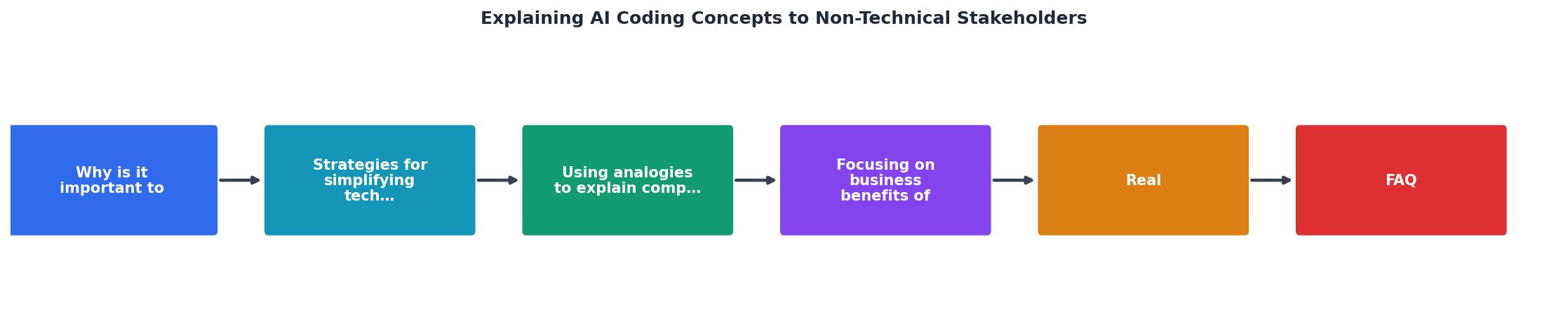
- Name it plainly: State the concept in one sentence without acronyms.
- Compare it to something the audience already knows (the analogy step).
- Land the impact: One sentence connecting the concept to time, cost, risk, or quality.
| Without Framework | With Framework |
|---|---|
| "We need RAG for the knowledge base" | "We need the AI to search our docs before answering, so it gives accurate responses instead of guessing" |
| "The context window is too small" | "The AI can only read 50 pages at a time; our contracts are 120 pages, so we need the larger plan" |
| "We should fine-tune the model" | "We retrain the AI on our own data so it understands our product terminology, reducing errors by ~30%" |
Presentation Prep Template
Before your next cross-functional meeting, fill in this checklist to make sure your explanation lands.
AI Concept Presentation Prep
Your progress is saved automatically in your browser.
For a deeper dive into the technical vocabulary itself, the key terms for AI developers resource pairs well with this communication framework. And if you are rolling out AI coding across a larger group, scaling AI projects with team strategies covers the operational side. The Vibe Coding Bible at vibecodingbible.org dedicates an entire chapter to bridging the gap between technical implementation and organizational buy-in.
FAQ
Frequently Asked Questions
Additional Resources
- Explaining tech to non-technical stakeholders - Medium - Use metaphors. Bridges, factories, post offices, architecture, and housing construction have all been metaphors I have used for explaining ...
- How to Explain Technical Writing to Nontechnical ... - Use relatable analogies: Compare technical concepts to everyday experiences or items that nontechnical stakeholders are already familiar with, making the ...
- AI explained for non-technical business leaders - This article aims to offer a comprehensive introduction to AI for executives and IT leaders, explaining foundational concepts like machine ...
Ready to Master Vibe Coding?
Learn to build software faster with AI assistance using the Vibe Coding Bible.
Get Started