Navigating Legal Considerations in AI Coding
Your team just shipped a feature in record time thanks to AI-generated code. Two weeks later, legal flags a GPL-licensed snippet buried in the output, and your proprietary product is now in violation. AI coding tools accelerate delivery, but they also introduce licensing, intellectual property, and compliance risks that most engineering leaders only discover after the damage is done. This guide breaks down the specific legal issues you need to address and gives you a concrete process to manage them.

Your team just shipped a feature in record time thanks to AI-generated code. Two weeks later, legal flags a GPL-licensed snippet buried in the output, and your proprietary product is now in violation. AI coding tools accelerate delivery, but they also introduce licensing, intellectual property, and compliance risks that most engineering leaders only discover after the damage is done. This guide breaks down the specific legal issues you need to address and gives you a concrete process to manage them.
TL;DR:- AI-generated code can contain fragments from copyleft-licensed training data, creating licensing exposure for your product.
- Copyright ownership of AI output remains legally unsettled in most jurisdictions, so treat AI code as unowned until reviewed.
- A repeatable compliance process (scan, review, document, audit) protects your team from the most common legal pitfalls.
- Transparency about AI usage in your codebase is both an ethical obligation and a practical risk-reduction strategy.
The legal landscape right now
The legal framework around AI-generated code is fragmented and evolving. Courts in the US, EU, and elsewhere are still working through foundational questions: Can AI output be copyrighted? Who is liable when AI code infringes on existing IP? What disclosure obligations apply?
As an engineering lead, you do not have the luxury of waiting for settled law. You are shipping software today, and every commit that includes AI-generated output carries risk. The three core areas to track are licensing, intellectual property ownership, and regulatory compliance.
That number is not hypothetical. AI-generated code is already a significant portion of production codebases at major companies, and the legal infrastructure has not caught up.
"For example, Microsoft CEO Satya Nadella recently estimated that 30% of Microsoft's production code is now generated by AI.">, Navigating the Legal Landscape of AI
Licensing risks in AI output
AI models like GitHub Copilot, Amazon CodeWhisperer, and open-source alternatives were trained on billions of lines of publicly available code. That training data includes code under every license imaginable: MIT, Apache 2.0, GPL, AGPL, LGPL, and proprietary code that leaked into public repositories.
When an AI model generates a function, it sometimes reproduces verbatim or near-verbatim snippets from its training data. If that snippet came from a GPL-licensed project, your proprietary codebase may now carry copyleft obligations you never intended.
Key licensing risks to watch:
- Copyleft contamination. GPL and AGPL code in AI output can trigger obligations to open-source your entire linked codebase.
- Attribution failures. MIT and Apache licenses require attribution. AI tools do not automatically provide it.
- License incompatibility. Mixing code from incompatible licenses (e.g., Apache 2.0 and GPLv2) creates legal conflicts that are hard to untangle after the fact.
- Training data provenance. You cannot verify what the model "saw" during training, making it difficult to prove clean-room development.
Practical steps for license management
- Run Software Composition Analysis (SCA) tools like FOSSA, Snyk, or Black Duck on every pull request that includes AI-generated code.
- Maintain an approved license list for your project. Block any dependency or snippet that falls outside it.
- Tag AI-generated code in commits (e.g.,
ai-generated: truein commit metadata) so auditors can trace provenance later. - Review your AI tool's terms of service. GitHub Copilot Business, for example, offers IP indemnification that the individual plan does not.
IP ownership: who owns AI code?

The US Copyright Office has stated that works generated entirely by AI, without meaningful human authorship, are not eligible for copyright protection. The EU AI Act takes a different angle, focusing on risk classification and transparency rather than authorship. Neither framework gives you a clean answer to the question every CTO asks: "Do we own the code our AI tools produce?"
Here is how the ownership question breaks down in practice:
- Purely AI-generated code (prompt in, code out, no modification): Likely not copyrightable. You cannot claim exclusive ownership, and neither can anyone else.
- AI-assisted code (developer writes prompt, reviews output, modifies and integrates): Stronger claim to copyright, because human creative input is demonstrable.
- AI-suggested code accepted verbatim: Gray area. The less human involvement, the weaker the ownership claim.
| Scenario | Human Involvement | Copyright Strength | Risk Level |
|---|---|---|---|
| Fully AI-generated, no edits | None | Very weak / none | High |
| AI-generated, minor edits | Low | Weak | Medium-high |
| AI-assisted, substantial edits | Medium | Moderate | Medium |
| Human-written, AI-reviewed | High | Strong | Low |
Protecting your IP in practice
- Require code review for all AI-generated output. Document the review in your PR process.
- Keep records of prompts and modifications. If ownership is ever challenged, you need evidence of human creative contribution.
- Check your employment and contractor agreements. Make sure they address AI-assisted work and assign IP to the company.
- If you are building a product where IP is a core asset (SaaS, developer tools, proprietary algorithms), consider restricting AI tool usage for the most sensitive modules.
Compliance requirements

Regulatory compliance for AI-generated software goes beyond licensing. Depending on your industry and jurisdiction, you may face requirements around:
- EU AI Act: Classifies AI systems by risk level. If your software falls into "high-risk" categories (healthcare, finance, critical infrastructure), you need conformity assessments, documentation, and human oversight mechanisms.
- GDPR and data privacy: AI tools that process user data during code generation (e.g., sending code context to cloud APIs) may trigger data processing obligations.
- SOC 2 / ISO 27001: If your organization holds these certifications, AI tool usage must be documented in your security policies and risk assessments.
- Export controls: AI models and certain generated code may be subject to export restrictions, particularly for defense or dual-use applications.
- Industry-specific regulations: HIPAA (healthcare), PCI DSS (payments), and FedRAMP (government) all have implications for how AI-generated code is validated and deployed.
The compliance process below gives you a repeatable framework for managing these requirements.
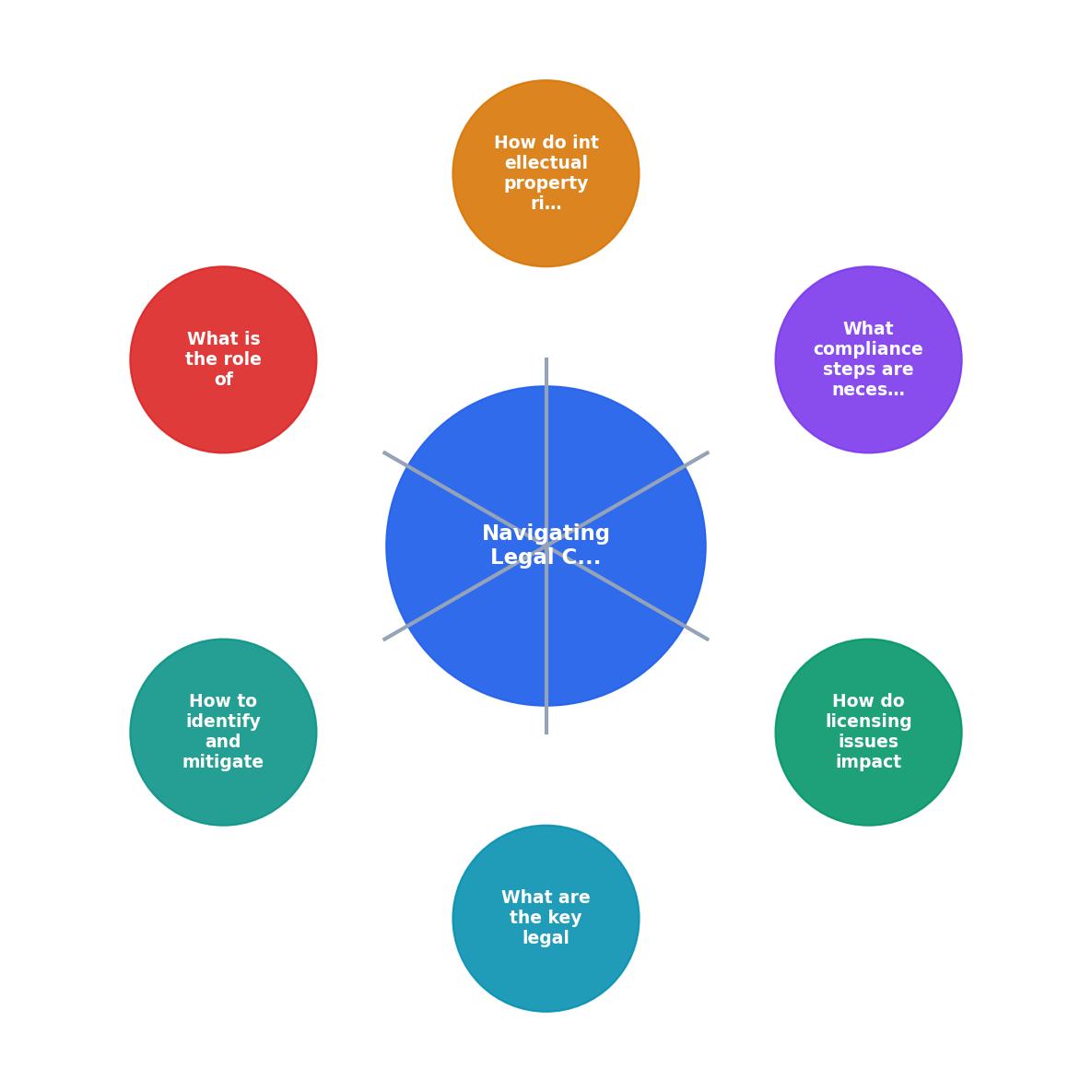
The diagram above outlines six steps: Identify AI Usage, Scan for Licenses, Review IP Exposure, Document Provenance, Validate Compliance, and Audit Regularly. Each step feeds into the next, creating a continuous loop rather than a one-time checklist.
Transparency and accountability
Using AI to write code is not the problem. Hiding it is. Transparency about AI usage in your codebase serves three purposes:
- Legal protection. If a dispute arises, documented AI usage shows good faith and enables faster resolution.
- Quality assurance. When reviewers know code is AI-generated, they apply appropriate scrutiny.
- Client and stakeholder trust. Clients increasingly ask whether AI was used in development. Having a clear answer builds confidence.
Identifying and mitigating risks
Here is a practical risk-management approach for engineering teams adopting AI coding tools:
The following interactive card summarizes the key risk categories and their mitigation strategies for a typical engineering organization using AI coding tools:
Copyleft Contamination
AI output may contain GPL/AGPL code. Mitigate with SCA scanning on every PR and duplicate detection filters.
IP Ownership Gaps
Unreviewed AI code weakens copyright claims. Require human review and document all modifications.
Data Privacy Exposure
Code context sent to AI APIs may include sensitive data. Use enterprise plans with data retention controls.
Regulatory Non-Compliance
AI usage may violate SOC 2, HIPAA, or EU AI Act requirements. Update security policies to cover AI tools.
Attribution Gaps
MIT/Apache snippets require attribution. Maintain a NOTICES file and scan for missing attributions quarterly.
Contract Gaps
Employment agreements may not cover AI-assisted work. Update contracts to assign AI-generated IP to the company.
Risk mitigation strategies
- Establish an AI usage policy. Define which tools are approved, which repositories they can be used on, and what review process applies. The Vibe Coding Bible at vibecodingbible.org covers team-level AI adoption policies in depth.
- Automate license scanning. Integrate SCA tools into your CI/CD pipeline so no AI-generated code reaches production without a license check.
- Train your team. Engineers need to understand the basics of software licensing and IP ownership. A 30-minute workshop saves months of legal headaches.
- Engage legal early. Do not wait for an incident. Bring your legal team into the AI adoption conversation from day one.
- Review vendor terms. Each AI coding tool has different terms around IP indemnification, data usage, and output ownership. Compare them before standardizing on a tool.
Legal Compliance Checklist for AI-Generated Software
Your progress is saved automatically in your browser.
FAQ
Frequently Asked Questions
Additional Resources
- Navigating the Legal Landscape of AI-Generated Code - AI‑generated coding not only challenges companies seeking to safeguard their intellectual property, it also exposes them to potential liability ...
- Navigating Legal Liability In AI Adoption: What Healthcare ... - AI assisted billing and coding impacts what is submitted to federal and state payors, which can give rise to liability if the billing contains ...
- Navigating the Legal and Ethical Landscape of AI ... - Review AI-generated code carefully. Don't assume that the output is free of errors or copyright issues. · Understand the tools you use.
Ready to Master Vibe Coding?
Learn to build software faster with AI assistance using the Vibe Coding Bible.
Get Started