Indicators of Quality in AI-Assisted Software Development
Your team adopted AI coding assistants three months ago. Velocity numbers look great on the sprint dashboard. But the bug backlog is growing, test coverage is dropping, and two senior engineers just spent a full week untangling a module that Copilot generated in an afternoon. Speed without quality indicators is just organized chaos, and as an engineering lead you need concrete metrics to tell the difference between genuine productivity and accelerated tech debt.

Your team adopted AI coding assistants three months ago. Velocity numbers look great on the sprint dashboard. But the bug backlog is growing, test coverage is dropping, and two senior engineers just spent a full week untangling a module that Copilot generated in an afternoon. Speed without quality indicators is just organized chaos, and as an engineering lead you need concrete metrics to tell the difference between genuine productivity and accelerated tech debt.
Photo by Jakub Zerdzicki from Pexels
TL;DR:- AI-generated code needs the same quality gates as human code, plus additional checks for duplication, hallucinated dependencies, and style drift.
- Track six core indicators: test coverage, cyclomatic complexity, duplication ratio, defect escape rate, review turnaround, and dependency hygiene.
- Use the checklist at the end of this article as a repeatable evaluation framework for every AI-assisted pull request.
Why quality indicators matter more now
Before AI assistants, a team's output was naturally throttled by typing speed and cognitive load. That friction was a built-in quality filter. An engineer who spent four hours writing a module also spent four hours thinking about edge cases. AI removes the friction but keeps the edge cases.
"With 91% adoption across engineering organizations, AI coding assistants have moved from experiment to essential infrastructure.">, AI
With adoption this high, the question is no longer whether your team uses AI. The question is whether you can tell good AI output from bad AI output before it reaches production. Quality indicators give you that lens. They turn subjective code review debates into objective, trackable signals that scale across a 5-person startup or a 200-person engineering org.
Without explicit indicators, teams default to the only metric leadership understands: velocity. And velocity without quality measurement is a loan with compounding interest.
Six core performance benchmarks

Not every metric matters equally. After working with teams that ship AI-assisted code daily, these six benchmarks consistently separate high-quality codebases from ticking time bombs:
- Test coverage delta tracks whether AI-generated code arrives with tests or without them. Measure the coverage percentage before and after each PR. A negative delta on any merge is a red flag.
- Cyclomatic complexity measures the number of independent paths through a function. AI models love generating deeply nested conditionals. Set a threshold (10 per function is a common ceiling) and enforce it in CI.
- Duplication ratio catches the copy-paste patterns AI assistants produce when they lack full project context. Tools like SonarQube, jscpd, or PMD flag duplicated blocks automatically.
- Defect escape rate counts bugs that reach production per release. Track this monthly. If the rate climbs after AI adoption, your review process has gaps.
- Review turnaround time measures hours from PR open to merge. AI can inflate PR volume, creating a review bottleneck. If turnaround climbs above 24 hours consistently, the team is drowning.
- Dependency hygiene checks whether AI-suggested packages actually exist (hallucinated packages are a real supply-chain risk), are maintained, and carry acceptable licenses.
Most teams track fewer than half of these. Start with test coverage delta and defect escape rate. They give you the fastest signal with the least tooling overhead.
The following dashboard card shows what a healthy snapshot looks like for a mid-size team running AI-assisted workflows:
AI Code Quality Dashboard (example team, weekly)
Evaluating code maintainability
Maintainability is where AI-generated code fails most quietly. The code works today. Six months from now, nobody on the team can modify it safely because:
- Naming is generic. AI defaults to
data,result,temp,handler. Enforce naming conventions in your style guide and lint rules. - Abstractions are flat. AI tends to produce long procedural functions instead of composable modules. Track average function length and file length as secondary indicators.
- Comments describe what, not why. AI-generated comments restate the code. Require "why" comments on non-obvious logic during review.
- Dead code accumulates. AI sometimes generates helper functions that nothing calls. Run dead-code analysis (e.g.,
ts-prunefor TypeScript,vulturefor Python) weekly.
maintainability label to your PR template. Reviewers check a box confirming they could modify this code confidently in three months. It takes two seconds and creates accountability.Compliance with industry standards

AI does not know your compliance requirements. It generates code that compiles, not code that passes an audit. Three areas need explicit gates:
- License compliance. AI may suggest code snippets derived from copyleft-licensed projects. Use tools like FOSSA or Snyk to scan every dependency and flag GPL/AGPL inclusions that conflict with your licensing model.
- Security standards. OWASP Top 10 violations show up regularly in AI output: SQL injection via string concatenation, missing input validation, hardcoded secrets. Run SAST (Static Application Security Testing) on every PR. SonarQube, Semgrep, and CodeQL all catch these patterns.
- Accessibility and data handling. If you operate under GDPR, HIPAA, or SOC 2, AI-generated code that logs PII or skips consent checks creates real liability. Add compliance-specific lint rules (e.g., no
console.logof user objects in production builds).
Teams that run SAST on AI-generated PRs report that roughly 40% get flagged on the first pass. That number drops below 10% within two months once developers learn to prompt for secure patterns and reviewers know what to look for.
Quality evaluation process
This diagram shows the end-to-end flow for evaluating AI-generated code quality, from generation through production monitoring:
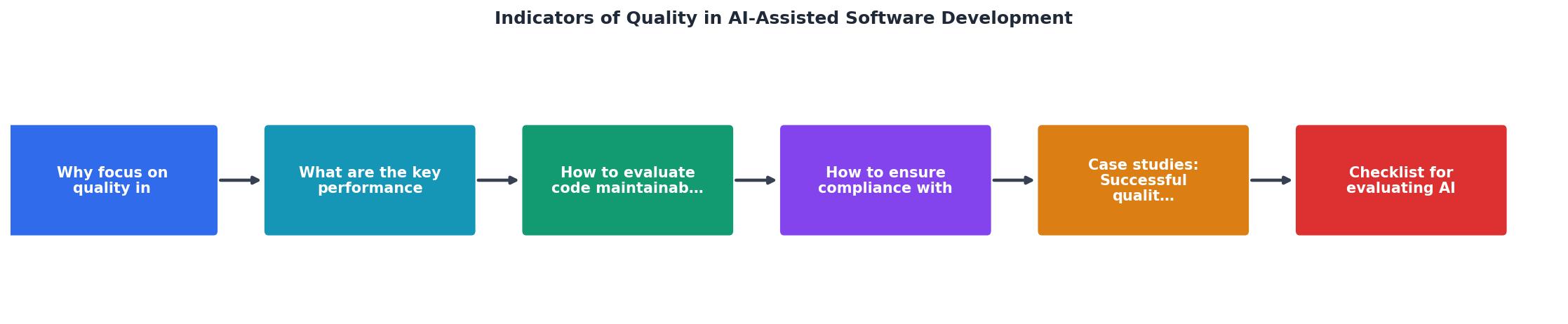
The process follows five stages: Generate, Lint & Scan, Review, Test, Monitor. Each stage has a gate. Code that fails a gate goes back to the previous stage, not forward. This is the same pipeline you use for human code, with two additions: dependency verification after Generate, and duplication analysis during Lint & Scan.
| Manual Code Pipeline | AI-Assisted Code Pipeline |
|---|---|
| Write code | Generate + verify dependencies |
| Lint | Lint + duplication + SAST scan |
| Peer review | Peer review + maintainability check |
| Unit tests | Unit tests + coverage delta check |
| Deploy + monitor | Deploy + monitor + defect escape tracking |
The right column is not dramatically different. That is the point. AI-assisted development does not need a new quality framework. It needs a slightly extended version of the one you already have.
Real-world quality management
A fintech startup with 12 engineers adopted Cursor and Claude for backend development in early 2025. Within six weeks, PR volume doubled. Defect escape rate tripled. The CTO introduced three changes:
- Mandatory test coverage delta check in CI (no negative deltas allowed).
- Weekly duplication ratio reports sent to the team Slack channel.
- A 15-minute "AI code spotlight" in each retrospective where the team reviewed one AI-generated module for maintainability.
Within eight weeks, defect escape rate dropped 85% from its peak and settled below pre-AI levels. The team kept the velocity gains. The difference was measurement and feedback loops, not restricting AI usage.
A similar pattern played out at a SaaS company with 60 engineers. They added Semgrep rules specifically targeting common AI output patterns (unused imports, overly broad exception handlers, hardcoded configuration values). The rules caught issues before human reviewers even opened the PR, cutting review turnaround by 30%.
Checklist for evaluating AI code
AI-Generated Code Quality Checklist
Your progress is saved automatically in your browser.
For a deeper dive into building these quality gates into your team's daily workflow, the Vibe Coding Bible at vibecodingbible.org covers AI-assisted quality management across 12 chapters with ready-to-use CI configurations and review templates.
FAQ
Frequently Asked Questions
What quality indicators has your team found most useful after adopting AI coding assistants? Share your experience below.
Additional Resources
- AI-assisted engineering: How AI is transforming software ... - Measure AI-driven time savings, developer satisfaction, quality indicators like change confidence and change failure rates. AI Impact Analysis ...
- How to Measure AI-Assisted Software Development - Learn how to measure AI-assisted software development with DORA, SPACE, quality guardrails, and realistic ROI benchmarks.
- 20 AI Performance Metrics to Follow in Software ... - The 2025 State of AI Code Quality shows teams using AI-assisted reviews reaching about 81% quality improvement versus roughly 55% without AI.
Ready to Master Vibe Coding?
Learn to build software faster with AI assistance using the Vibe Coding Bible.
Get Started